
Evidence-Based Decision-Making in Nursing
Key Points
- Evidence-based decision-making (EBDM) applies evidence-based practice to individual patient-care decisions.
- EBDM integrates scientific evidence, clinical experience, and patient values.
- Unlike idealized EBP models, EBDM must also account for real setting constraints.
- Strong decisions are both evidence-aligned and feasible in the current care environment.
- In public health, EBDM extends evidence appraisal to include community context, partner buy-in, feasibility, cost-effectiveness, sustainability, health equity, and public sentiment.
- EBDM is a lifelong nursing expectation and should replace tradition-only care habits.
- ANA Standard 13 expects the RN to integrate evidence and research findings into practice.
- Translation science focuses on moving evidence-based research into routine, sustainable care.
- Practical EBP workflows can use either a five-step appraisal-to-outcome loop or a seven-step inquiry-to-dissemination loop.
- Public-health EBDM commonly uses a seven-step cycle: define, search, appraise, synthesize, adapt, implement, and evaluate.
- PICOT question structure clarifies searchable scope and outcome measurement in both bedside and population decision workflows.
- Structured communication tools (for example ISBAR) help teams apply evidence consistently at handoff and transition points.
- ANA scholarly-inquiry competencies include asking practice questions, sharing peer-reviewed findings, and using research ethically to improve care quality.
- QSEN EBP expectations include distinguishing clinical opinion from evidence summaries and consulting experts before deviating from evidence-based protocols.
- Staying current requires routine use of bedside evidence tools, journals, conferences, and continuing education.
- Nutrition trend counseling requires explicit separation of scientific evidence from anecdotal testimonials.
- Social-media nutrition claims should be screened for author qualification, credible network support, external validation, contextual consistency, account maturity, and reliability.
- Evidence implementation should avoid one-size-fits-all recommendations by checking population fit, SDOH constraints, and health-equity relevance.
- High-quality population decisions require multiple evidence forms (quantitative, qualitative, surveillance, focus-group, and needs-assessment data) and disaggregated/intersectional analysis.
- Efficient evidence retrieval depends on using high-yield databases/registries and phase-matched EBDM tools (question framing, search tracking, appraisal templates, adaptation and evaluation checklists).
- Public-health decisions should align with Essential Public Health Functions and Essential Public Health Services while accounting for SDOH and local safety/access realities.
- Evidence weighting should explicitly include appraisal domains: intended audience, purpose, relevance, applicability, validity, and reliability.
Pathophysiology
Clinical outcomes depend on timely, context-aware decisions at bedside. Even when high-quality evidence exists, safe implementation may be limited by policy, staffing, resources, or workflow realities. EBDM reduces decision gaps by combining best evidence with what is realistically deliverable now.
Classification
- Evidence component: Current research and guideline-supported interventions.
- EBPH linkage component: EBDM operationalizes evidence-based public health by combining research evidence with local context, systems data, and community engagement.
- Research-purpose component: Basic research describes or explains what is happening, while applied research tests practice changes based on existing evidence.
- EBP-versus-research purpose component: EBP applies current evidence to care decisions; research generates new nursing knowledge for future practice.
- Pathway component: Use of clinical pathways and core measures to standardize evidence application.
- Pathway structure detail: Clinical pathways act as multidisciplinary care plans that translate policy, guidelines, and evidence into bedside workflow.
- Pathway algorithm use: High-risk pathways (for example ACLS) sequence medications and actions by patient response.
- Core-measure governance: Core measures are evidence-based standards aligned with The Joint Commission and CMS quality expectations.
- Core-measure alignment history: Joint Commission and CMS quality-specification alignment reduced reporting variation and strengthened common national inpatient quality measurement.
- Core-measure system aims: Core measures support quality-improvement measurement, consumer decision support, value-based payment/purchasing, reduced metric variability, and lower data-collection burden.
- Core-measure example set: Common domains include immunization, tobacco/substance-treatment workflows, joint-replacement pathways, stroke/cardiac care, hypertension management, and high-risk-medication safety in older adults.
- Expertise component: Nurse clinical judgment, pattern recognition, and prior experience.
- Values component: Patient goals, preferences, and acceptable trade-offs.
- Context component: Unit policy, available resources, and operational constraints.
- Scholarly-inquiry competency component: Identify answerable practice questions, apply research ethically, and integrate peer-reviewed findings into nursing practice improvement.
- ANA EBP cycle component: Ask a clinical question, acquire evidence, appraise evidence, apply evidence, assess outcomes.
- Seven-step EBP component: Spirit of inquiry, ask question, search evidence, appraise evidence, integrate into practice, evaluate outcomes, share results.
- NCCMT EBDM seven-step component: Define problem, search literature/data, appraise quality/relevance, synthesize findings, adapt to local context, implement intervention, and evaluate effectiveness.
- PICOT construction component: Population, intervention, comparison, outcome, and time frame define answerable practice/public-health questions.
- Evidence-form component: Quantitative evidence (numeric outcomes), qualitative evidence (experiences/attitudes/behaviors), and focus-group/community-input data are integrated for population decisions.
- Evidence-appraisal criteria component: Intended audience, purpose statement, relevance to question, applicability to target population, validity/credibility, and reliability/reproducibility.
- 6S evidence-hierarchy component: Prioritize higher synthesized evidence when quality and local applicability are sufficient.
- Population-data component: Community needs assessments, windshield surveys, morbidity/mortality sources, and surveillance systems inform local problem definition.
- Evidence-source infrastructure domain: Databases and registries (for example AHRQ, CINAHL, Cochrane, JBI, Medline, PubMed, disease registries, and Community Guide resources) support efficient intervention selection.
- Equity-analytics component: Disaggregated and intersectional analysis helps detect disparities hidden in aggregate data.
- Public-health evidence-source component: Decisions integrate research findings, community/local context, community-political preferences/actions, available resources, and decision-maker expertise.
- EPHF/EPHS alignment domain: Program decisions should map to core public-health action sets (monitoring/surveillance, emergency response, governance/policy, workforce, access/quality, prevention, and community engagement).
- Research-ethics protection domain: Evidence generation and local data collection must follow respect for persons, beneficence, justice, and informed-consent safeguards.
- Representation-gap domain: Underrepresentation of marginalized groups can reduce generalizability and bias intervention selection.
- QSEN EBP-KSA component: Integrate evidence with expertise and client values, differentiate opinion from evidence, and seek expert input before protocol deviation.
- QSEN EBP competency alignment: Integrate scientific evidence, clinician expertise, and client/family preferences to optimize care decisions.
- Evidence-strength component: Hierarchy and level frameworks that rank methodological rigor while still considering consistency and clinical relevance.
- Evidence-currency component: Employer-provided bedside evidence tools, professional journals, conferences, and continuing education used for ongoing practice updates.
- Community-prevention evidence-source domain: Program selection can leverage SAMHSA evidence-based resource repositories and validated prevention-practice registries.
- Translation component: Implementation planning for stakeholder buy-in, policy/procedure alignment, and sustainability at unit or facility level.
- Model component: Structured implementation models (for example Iowa, Joanna Briggs, and Johns Hopkins) support larger-scale change management.
- PET model component: JHEBP organizes initiative work into practice question, evidence, and translation phases.
- Communication-support component: Standardized handoff tools (such as ISBAR/SBAR) support rapid, reproducible sharing of evidence-relevant clinical information.
- Decision-support component: Clinical decision support tools embedded in EHR/point-of-care systems improve repeatability across clinicians, settings, and patient populations.
- Bias-control component: Cognitive bias can distort evidence use; routine self-reflection and team cross-checking reduce avoidable decision errors.
- Nutrition-trend appraisal component: Popular diet patterns should be evaluated for evidence quality, safety profile, and patient-specific clinical fit before recommendation.
- Digital nutrition credibility component: Online claims are screened by poster qualifications, credible-network linkage, cross-source validation, contextual consistency, account age, and reliability.
- Equity-fit component: Evidence selection should account for SDOH burden and avoid universal recommendations that are not feasible across diverse populations.
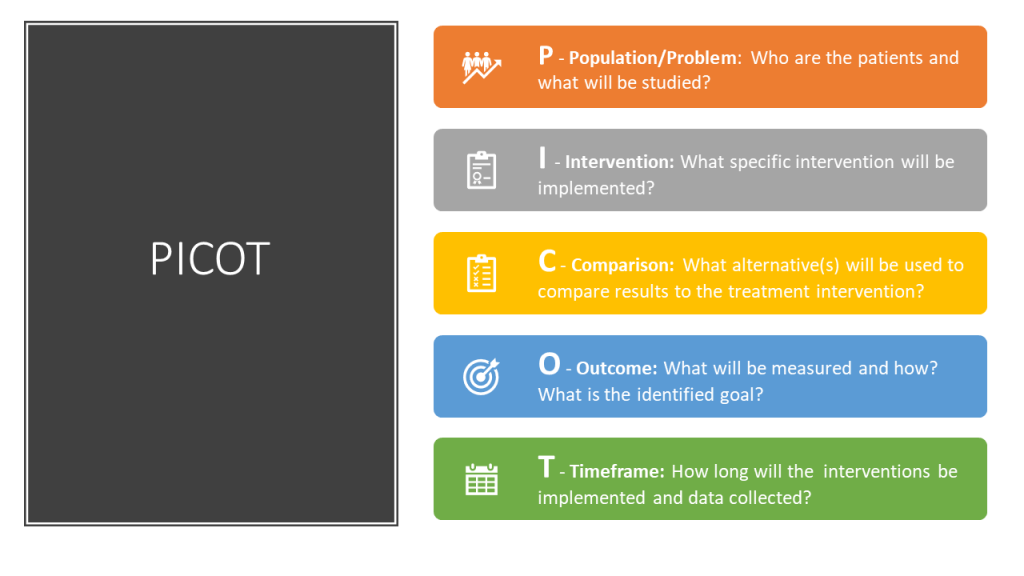 Illustration reference: OpenRN Nursing Management and Professional Concepts 2e Ch.9.4.
Nursing Assessment
NCLEX Focus
Best evidence is necessary but not sufficient; ask whether the option is feasible and patient-aligned in this setting.
- Identify the clinical question and immediate patient priority.
- Compare candidate interventions against available evidence strength.
- Evaluate patient-specific factors, preferences, and barriers.
- Assess whether current self-management choices are being driven by social-media nutrition claims and identify the exact claims being followed.
- Check environmental constraints (policy, equipment, staffing, timing).
- Verify whether relevant clinical pathways or core measures apply.
- Verify pathway/core-measure triggers and required documentation elements before implementation.
- Verify that planning resources are credible and current before applying them in care decisions.
- Verify evidence quality and applicability by checking design strength, sample relevance, and methodological limits.
- Verify whether the recommendation is supported by scientific data rather than anecdotal stories, influencer testimonials, or single-post narratives.
- Verify credibility of digital nutrition information using a structured check (qualified poster, credible network, external validation, contextual consistency, account age, and reliability).
- Verify whether the rationale for deviating from protocol is evidence-valid rather than preference-only or habit-based.
- Verify evidence strength using hierarchy/level frameworks (for example synthesis studies, trials, observational studies, and expert consensus) before implementation.
- Verify that the clinical question is searchable, appropriately scoped, and built with specific keywords.
- Verify publication recency when possible (often within three to five years), while retaining seminal evidence that remains practice-defining.
- Verify that interpretation is not being driven by familiarity alone; compare personal impressions against current high-quality evidence.
- Verify supplement-label language type (health, nutrient-content, structure/function) and avoid interpreting marketing wording as proof of clinical efficacy.
- Verify language access, cultural preferences, and realistic social/resource constraints before finalizing the plan.
- Verify PICOT components are explicit before literature search to reduce scope drift.
- Verify whether evidence includes local/community and surveillance data rather than research-only inputs.
- Verify disaggregated subgroup patterns (for example race/ethnicity/language/SES intersections) to avoid masking inequities.
- Verify appraisal domains directly before weighting a source: audience, purpose, relevance, applicability, validity, and reliability.
- Verify decision alignment with applicable public-health function expectations (surveillance, prevention, equity, access, and workforce capabilities).
- Verify that proposed nutrition recommendations are feasible in the patient’s social and environmental context rather than one-size-fits-all advice.
- Choose the highest-value option that is both evidence-supported and feasible.
Nursing Interventions
- Implement selected intervention with clear rationale documentation.
- Define the question in PICOT format before selecting evidence sources.
- Use concise team communication to align decisions across disciplines.
- Monitor objective and subjective response data after implementation.
- Escalate or revise when response is inadequate or constraints change.
- Feed outcome learning back into future decision quality.
- Use a structured EBP sequence explicitly when implementing change (for example ANA five-step cycle or seven-step inquiry-to-dissemination model).
- For group-level changes, build interprofessional stakeholder support, implementation timelines, and dissemination plans before spread.
- In public-health decisions, engage community partners early and include feasibility, sustainability, and equity checks during adaptation.
- Use formal evidence-level/quality ranking templates before synthesis decisions.
- Use structured communication (for example ISBAR) during escalation, transfers, and interdisciplinary updates to preserve evidence-critical details.
- Align implementation and documentation with accreditor/CMS quality-measure requirements when the intervention maps to a core-measure domain.
- Seek consultation when clinical expertise is insufficient for a complex decision rather than defaulting to unsupported assumptions.
- Share relevant peer-reviewed findings with colleagues to promote unit-level evidence uptake.
- Maintain a recurring evidence-currency workflow using bedside tools, journals, conferences, and CE updates.
- Use decision-support tools by phase: clinical lookup tools (for example UpToDate/Lexicomp) for point-of-care choices and structured EBDM toolkits/checklists for multistep public-health decisions.
- Use curated database/registry search plans and trackers to avoid ad hoc evidence sampling and missed high-quality sources.
- For community prevention planning, use curated evidence repositories (for example SAMHSA resource-center pathways) before selecting new public interventions.
- Coach patients to apply a repeatable credibility checklist before adopting social-media nutrition advice.
- Redirect patients from anecdote-driven diet trends to evidence-supported guidance and qualified professional follow-up.
- In supplement counseling, explain that premarket regulatory review for safety/effectiveness is limited and that product-selection decisions should be indication-based with dose verification against age/sex-specific recommendations.
- Tailor nutrition teaching to cultural, language, and environmental context so evidence use supports practical health-equity goals.
- If local evidence is missing for a target population, initiate ethically reviewed data collection plans rather than extrapolating from poorly matched studies.
Feasibility Blind Spot
Choosing an intervention that is evidence-strong but operationally impossible can delay effective care.
Pharmacology
Medication choices in EBDM should balance evidence hierarchy, patient preference/adherence potential, and local formulary or policy limits.
Clinical Judgment Application
Clinical Scenario
A patient with swallowing difficulty requires an ordered medication currently listed in solid form.
- Recognize Cues: Aspiration risk and administration barrier are present.
- Analyze Cues: Standard route may be unsafe for this patient.
- Prioritize Hypotheses: Alternative formulation could preserve efficacy and safety.
- Generate Solutions: Request evidence-supported liquid alternative and adjust administration plan.
- Take Action: Coordinate order update and monitor response.
- Evaluate Outcomes: Medication is delivered safely with therapeutic effect.
Related Concepts
- ppmp-clinical-decision-making-framework - Structured approach for proactive decision sequencing.
- quality-assurance-and-donabedian-model-in-nursing-evaluation - Connects bedside decisions with quality outcomes.
- evaluation-conclusions-goal-met-unmet-or-terminate - Post-decision outcome evaluation and plan adjustment.
- nursing-research-methodology-and-human-subject-protections - Supports appraisal of evidence quality and ethical integrity before adoption.
- isbar-clinical-handoff-communication - Standardized handoff structure that supports evidence-consistent team decisions.
- community-health-needs-assessment-and-program-planning - Community-level data and stakeholder pathways that strengthen EBDM adaptation and implementation.
Self-Check
- Why is situational feasibility essential in EBDM?
- How do patient values alter evidence-based option selection?
- What should trigger a rapid decision revision after implementation?