
Asthma Action Plan and Exacerbation Management
Key Points
- Asthma is chronic airway inflammation with episodic bronchoconstriction, mucus increase, and variable airflow limitation.
- Exacerbations include an early mediator-driven bronchoconstrictive phase and a late inflammatory-cell recruitment phase.
- Symptoms include wheezing, dyspnea, chest tightness, and nighttime or early-morning cough, with asymptomatic periods between attacks.
- Quick-relief medications treat acute symptoms, while long-term control therapy prevents recurrent exacerbations.
- Asthma Action Plans use Green, Yellow, and Red zones with peak flow thresholds to guide timely self-management and escalation.
- Status asthmaticus is a life-threatening emergency requiring rapid oxygenation, intensive bronchodilation, corticosteroids, and close monitoring.
- During pregnancy, poor asthma control increases maternal-fetal morbidity risk and requires early exacerbation treatment.
Health Disparities
Asthma burden is not evenly distributed. In the United States, Black, Hispanic, and American Indian/Alaska Native populations have higher rates of asthma-related hospitalization and death. Structural barriers, social determinants of health, environmental pollution exposure, and uneven access to specialist care contribute to these outcomes.
Nursing priorities include culturally and linguistically appropriate teaching, action-plan tailoring to family context, and reduction of avoidable barriers to medication access and follow-up care. In mortality-focused risk framing, Black Americans have substantially higher asthma death risk than White Americans, with especially high risk in Black women. In population-risk framing from historically disinvested neighborhoods, former redlined areas show higher pollutant burden and are associated with higher asthma emergency utilization and mortality.
Pathophysiology
Asthma is driven by chronic airway inflammation that narrows bronchial passages and increases airway hyperresponsiveness. During exacerbations, bronchial smooth muscle constricts and mucus production increases, worsening airflow obstruction.
Early-phase exacerbation is commonly trigger-mediated (for example allergens, cold air, or exercise), with antibody-linked mast-cell and basophil activation that releases leukotrienes, histamine, and prostaglandins, producing bronchoconstriction.
Late-phase exacerbation is characterized by inflammatory-cell recruitment (for example eosinophils, neutrophils, basophils, and T-cell subsets), with persistent inflammation, increased mucus, and sustained airway narrowing.
Clinical severity fluctuates from mild intermittent to severe persistent patterns. Exacerbations can be triggered by allergens, exercise, tobacco smoke, air pollutants, cold air, gastroesophageal reflux, and strong emotion. Repeated uncontrolled episodes increase risk for respiratory compromise and emergency utilization.
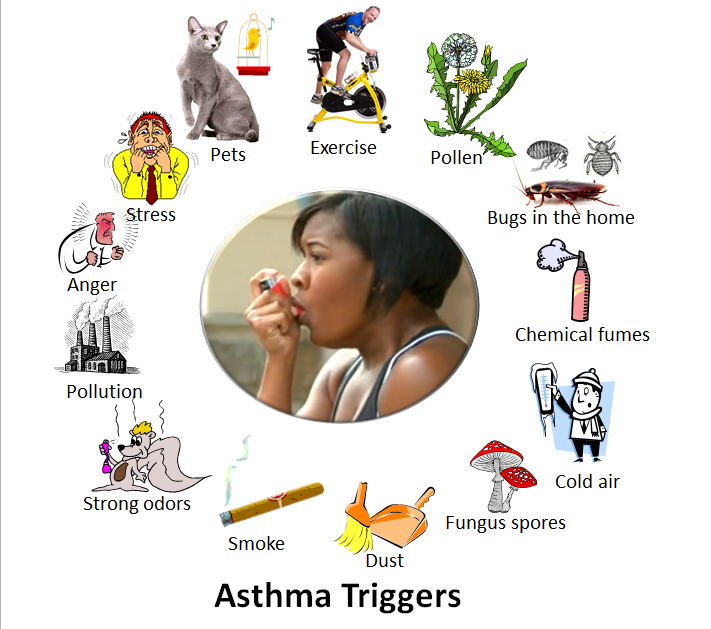 Illustration reference: OpenRN Health Alterations Ch.6.5.
Risk profiles also include family history, prematurity, maternal smoking exposure during pregnancy, obesity, and coexisting allergic conditions such as eczema.
Classification
- Green Zone (good control): Symptoms controlled, usual activity maintained, and peak flow at least 80% of personal best.
- Yellow Zone (caution): Worsening symptoms with peak flow 50-79% of personal best; requires added quick-relief therapy and provider contact per plan.
- Red Zone (medical alert): Severe or worsening symptoms not relieved by rescue therapy; requires urgent emergency escalation.
- Symptom-severity stage: Intermittent (<2 symptom days/week, <2 nighttime awakenings/month), mild persistent (>2 symptom days/week but not daily, 3-4 nighttime awakenings/month), moderate persistent (daily symptoms, nighttime awakenings >1/week), and severe persistent (daily symptoms throughout day with frequent nighttime awakenings).
Nursing Assessment
NCLEX Focus
Prioritize airway and oxygenation cues first, then determine action-plan zone and response to rescue therapy.
- Assess wheezing, dyspnea, chest tightness, nocturnal symptoms, and early-morning cough patterns.
- Assess work of breathing, activity tolerance, and ability to speak during acute symptoms.
- Verify pulse-oximetry reliability by correlating waveform and measured pulse with clinical pulse before acting on saturation changes.
- Review trigger exposure history and recent symptom frequency to evaluate control status.
- Review medication-trigger history, including NSAID-associated bronchospasm patterns in susceptible clients.
- Monitor peak expiratory flow rate (PEFR) trends against the client’s personal best.
- Assess neighborhood and housing exposure context (for example high-traffic corridors, industrial pollution, poor ventilation, or mold burden) when asthma remains uncontrolled.
- Assess home trigger burden from housing quality (carpet dust load, indoor smoke transfer, leaks/mold, and pest exposure) when recurrent exacerbations continue despite medication adherence.
- Interpret spirometry context: reduced FEV1 with meaningful post-bronchodilator improvement supports asthma diagnosis.
- Use asthma-focused spirometry cues: FEV1 under about 80% predicted and FEV1/FVC under about 0.70 support obstructive airflow limitation.
- Recognize methacholine challenge and allergen testing as follow-up diagnostics when routine testing is inconclusive.
- Recognize exhaled nitric oxide and eosinophil elevation as supportive inflammatory evidence when interpreted with full clinical context.
- Identify red-flag deterioration signs including cyanosis, worsening hypoxemia, reduced alertness, and poor bronchodilator response.
- Escalate immediately for severe-attack cues such as cyanotic lips or face, confusion or drowsiness, diaphoresis, and rapid weak pulse.
Nursing Interventions
- Teach trigger recognition and avoidance plans tailored to home, school, or work exposures.
- Include food-trigger review for susceptible clients (for example sulfite-containing preserved foods) when exacerbation pattern suggests dietary triggers.
- Reinforce nutrition-pattern support for control: favor fruit/vegetable/whole-grain intake and limit high-fat, highly processed dietary patterns that can worsen airway inflammation.
- If the client chooses a restrictive pattern (for example strict plant-based elimination plans), coordinate dietitian support to reduce micronutrient-deficiency risk.
- In clients with NSAID-sensitive asthma patterns, reinforce provider-directed avoidance of triggering NSAIDs and discuss safer analgesic alternatives such as acetaminophen when appropriate.
- For substandard-housing triggers, teach practical exposure reduction steps and coordinate referral to housing-support or environmental-health resources when feasible.
- For unavoidable triggers (for example exercise, strong emotions, hormonal shifts, or respiratory illness), teach anticipatory self-management based on personal response pattern.
- During active attacks, use calm reassurance while escalating breathing difficulty immediately per emergency pathway.
- Reinforce correct inhaler and nebulizer technique for both controller and rescue medications.
- For inhaled corticosteroid regimens, teach mouth rinsing after each dose and spacer use when indicated to reduce oral candidiasis risk.
- Teach and rehearse written Asthma Action Plan steps for Green, Yellow, and Red zones.
- In school-age care, coordinate annual asthma-action-plan updates with the student’s PCP, family, and school nurse so rescue/escalation steps are executable during school hours.
- Promote upright or tripod positioning and paced breathing strategies during dyspnea episodes.
- Collaborate with school staff to reduce trigger exposure in classrooms and activity settings (for example smoke, mold, and high-exposure environmental triggers).
- Support immunization adherence (influenza, pneumococcal, RSV, pertussis, and COVID) to reduce infectious exacerbation risk.
- Teach zone-specific home actions with written materials and teach-back for client/family understanding.
- Encourage calming strategies during dyspnea (focused breathing, guided imagery, progressive relaxation) to reduce anxiety-amplified symptoms.
- For pregnancy exacerbations, reinforce that albuterol remains first-line rescue therapy and escalate quickly when symptoms persist.
- Use systemic corticosteroids judiciously during pregnancy when severe or persistent symptoms outweigh fetal and maternal risk concerns.
Escalation Timing Is Critical
In Red Zone symptoms, immediate rescue medication and emergency escalation are required; delayed response increases risk for respiratory failure.
Pharmacology
| Drug Class | Examples | Key Nursing Considerations |
|---|---|---|
| short-acting beta-agonists | albuterol, levalbuterol | Rescue use for acute bronchoconstriction; onset is typically within about 15-30 minutes in this context. |
| inhaled corticosteroids | fluticasone, budesonide | Core long-term anti-inflammatory control; reinforce adherence. |
| ICS-LABA combination inhalers | fluticasone/salmeterol | Combined prevention strategy for persistent symptoms. |
| systemic corticosteroids | prednisone, methylprednisolone | Used for Yellow/Red escalation; monitor response and adverse effects. |
| leukotriene modifiers | montelukast | Long-term prevention option for selected clients. |
| long-acting muscarinic antagonists | tiotropium | Add-on option in moderate persistent disease using dry-powder or mist inhaler delivery. |
| mast cell stabilizers | cromolyn | Can help selected allergic or exercise-induced patterns but is used less often due to more effective options. |
| methylxanthines | theophylline | Narrow therapeutic index; requires serum-level monitoring. |
| anti-IgE monoclonal antibodies | omalizumab | Severe allergic asthma option; monitor for treatment response and reactions. |
| immunomodulators | mepolizumab | Severe eosinophilic asthma option; monitor efficacy and adverse effects. |
Severe Exacerbation and Status Asthmaticus
Status asthmaticus is a severe asthma emergency unresponsive to usual rescue therapy. Hallmarks include severe airway obstruction, worsening hypoxemia, declining alertness, cyanosis, and possible “silent chest” (minimal breath sounds).
Escalation treatments can include high-flow oxygen, IV corticosteroids, continuous nebulized bronchodilators, IV magnesium sulfate, and intubation/mechanical ventilation when hypoxia or hypercapnia persists. Continuous vital-sign, oxygen-saturation, and ECG monitoring are required because severe hypoxia may precipitate dysrhythmias.
Pediatric red-zone cues may include nasal flaring, belly breathing, grunting, agitation/sluggishness, and reduced interaction with caregivers.
Nursing Diagnoses and Outcomes
Common diagnoses include ineffective airway clearance, anxiety, and readiness for enhanced health self-management.
Expected outcomes include accurate inhaler technique, correct peak-flow use, correct action-plan use during worsening symptoms, and verbalized trigger-control strategies. Trend outcomes should include reduced overall symptom frequency, fewer nighttime awakenings, and reduced rescue-medication demand.
Clinical Judgment Application
Clinical Scenario
An adult client with asthma reports increased nighttime cough, daytime wheeze, and a home peak flow reading at 62% of personal best despite baseline controller use.
- Recognize Cues: Worsening symptom pattern plus PEFR in the Yellow Zone.
- Analyze Cues: Control has deteriorated and risk of severe exacerbation is increasing.
- Prioritize Hypotheses: Highest priority is preventing progression to Red Zone respiratory compromise.
- Generate Solutions: Implement Yellow Zone medications, reinforce inhaler technique, and contact provider per plan.
- Take Action: Administer prescribed quick-relief and adjunct therapy, update trigger control plan, and monitor closely.
- Evaluate Outcomes: PEFR trends upward, dyspnea decreases, and no emergency transfer is required.
Related Concepts
- respiratory-system - Core anatomy and gas-exchange context for airflow obstruction.
- chronic obstructive pulmonary disease (COPD) - Differential chronic obstructive pattern requiring distinct management pathways.
- pneumonia - Respiratory infection that can worsen asthma control and trigger exacerbations.
- anaphylaxis - Acute airway-compromising condition that may mimic severe respiratory distress.
- oxygen-therapy - Supportive intervention during severe hypoxemia and status asthmaticus.
Self-Check
- Which peak flow percentages define Green and Yellow zone management decisions?
- Why must quick-relief and long-term control medications be taught as separate roles?
- Which findings indicate progression from a worsening attack to a life-threatening asthma emergency?