
Sepsis
Key Points
- Sepsis: life-threatening organ dysfunction from an exaggerated immune response to infection; 1.7 million US cases/year with ~270,000 deaths
- “For each hour treatment is delayed, mortality increases 4–9%” — early recognition is priority
- Bacteremia is presence of bacteria in blood; septicemia is bacteremia with active bloodstream multiplication.
- qSOFA screening: SBP <100 mmHg + altered mental status + RR >22 — score ≥2 = sepsis suspected
- First intervention: Blood cultures BEFORE antibiotics → broad-spectrum antibiotics immediately
- Lactate <2 mmol/L = acceptable; >4 mmol/L = high mortality, aggressive volume resuscitation required
- MAP >65 mmHg = adequate perfusion; urine output ≥30 mL/hr = adequate kidney perfusion
Pathophysiology
Stages of Sepsis
- SIRS (Systemic Inflammatory Response Syndrome): Diffuse systemic inflammatory response to a major stressor (for example infection, trauma, or burn) with fever/hypothermia, tachycardia, tachypnea, and leukocyte abnormalities; SIRS is not equivalent to sepsis unless infection-driven organ dysfunction is present.
- Sepsis: Overreaction of the immune system to infection → exaggerated systemic inflammatory response
- Severe Sepsis: Organ dysfunction present (AKI, ARDS, hepatic failure, coagulopathy)
- Septic Shock: Persistent hypotension despite adequate IV fluid administration → decreased cellular perfusion → multi-organ failure
Mechanism
Most commonly caused by gram-negative bacterial infections (endotoxin release). Can also result from gram-positive, viral, or fungal infections.
Bloodstream terminology:
- Bacteremia: Presence of bacteria in blood.
- Septicemia: Bacteria present and multiplying in the blood.
Pathophysiologic cascade:
- Endotoxins released → massive capillary permeability ↑ → fluid shifts to interstitial space → profound hypotension
- Decreased O2 delivery → cells switch from aerobic to anaerobic metabolism → lactic acidosis and metabolic acidosis
- Sympathetic compensation: tachycardia → further increases O2 demand of heart
- Neuroendocrine stress activation can create a hypermetabolic state that further raises cellular oxygen demand
- Risk of DIC (disseminated intravascular coagulation): microclots consume clotting factors → massive bleeding
Warm Shock vs. Cold Shock
| Phase | Timing | Hemodynamics | Skin Findings |
|---|---|---|---|
| Warm shock (early) | First 6–72 hours | ↑ Cardiac output, ↓ SVR | Warm, flushed, bounding pulses, ↓ cap refill |
| Cold shock (late) | Progressive deterioration | ↓ Cardiac output, ↑ SVR | Mottled, cool, pale; cyanotic extremities |
Risk Factors
High-risk populations:
- Age >65 years (>60% of sepsis diagnoses)
- Immunosuppression (cancer, transplant, AIDS, corticosteroid use)
- Chronic illness: diabetes mellitus, CKD, heart failure
- Hematologic malignancy risk states (for example leukemia)
- Urinary infection source (especially in older adults and catheterized patients)
- Recent surgery, artificial joints, heart valve replacement
- Pregnancy
- Substance abuse, malnourishment
Older Adults and Sepsis
Change in mental status is often the first clinical manifestation of sepsis in older adults — any sudden mental status change in an elderly patient should trigger sepsis screening.
Clinical Manifestations
Early (warm shock):
- Tachycardia, tachypnea (RR >22)
- Hyper- or hypothermia (fever with chills)
- Confusion, agitation, altered mental status
- Warm, flushed skin; bounding pulses
Progressive:
- Hypotension (SBP <100 mmHg)
- Decreased urine output (<30 mL/hr) — renal hypoperfusion
- Respiratory distress → ARDS (fluid into alveolar space)
- Increasing lactate (anaerobic metabolism)
Late (cold shock):
- Mottled skin — purplish discoloration from cutaneous hypoperfusion
- “Septic skin rash” — pinprick-sized blood spots (petechiae)
- Coma, organ failure, DIC, death
qSOFA Screening Tool
Each criterion = 1 point; score ≥2 = sepsis suspected → initiate treatment:
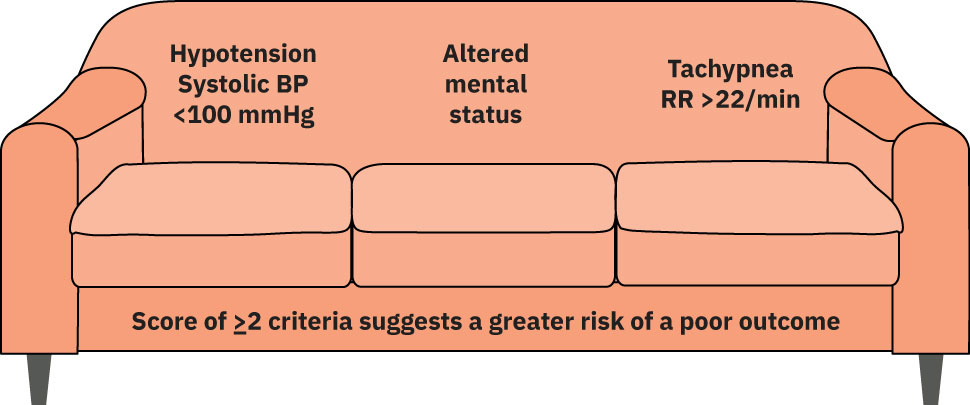 Illustration reference: OpenStax Medical-Surgical Nursing Ch.23.3.
| Criterion | Threshold |
|---|---|
| Systolic blood pressure | <100 mmHg |
| Altered mental status | Any change from baseline |
| Respiratory rate | >22 breaths/minute |
Early Escalation Cues in Known Infection
For frontline long-term-care reporting, immediate nurse escalation is warranted when a patient with known/suspected infection has two or more of these findings:
- Temperature >38 C (100.4 F) or <36 C (96.8 F)
- Heart rate >90/min
- Respiratory rate >20/min
- Systolic blood pressure <90 mmHg
- PaCO2 <32 mmHg (if available)
- WBC >12,000/mm3 or <4,000/mm3, or >10% immature bands
These cues support rapid reassessment for potential Sepsis progression, especially when combined with new confusion or functional decline in older adults.
Diagnostic Tests
| Test | Normal | Sepsis Concern |
|---|---|---|
| Blood culture | No infectious agent | Pathogen identified (definitive test) |
| Lactate | <2 mmol/L | >2 mmol/L (concern); >4 mmol/L = high mortality |
| Procalcitonin | Undetectable (≈0) | >2.0 mcg/L |
| WBC | 4,500–11,000/mcL | <4,000 or >12,000 |
| D-dimer | <0.50 | >0.50 (DIC risk) |
| PT/PTT | PT 10–13 sec; PTT 25–35 sec | Elevated (impaired clotting) |
| Platelets | 150,000–450,000 | Low (platelet aggregation in DIC) |
| C-reactive protein (CRP) | Low | Elevated (inflammation marker) |
Additional cultures: urine, sputum, wound, CSF (if meningitis suspected). Blood-culture confirmation commonly requires about 1-3 days, so empiric treatment should not be delayed when sepsis is suspected.
Medical Management
Sepsis Bundle (Hour-1 Bundle)
- Blood cultures × 2 (before antibiotics)
- Broad-spectrum antibiotics immediately — do not delay for culture results
- Fluid resuscitation: 30 mL/kg crystalloid (normal saline or Lactated Ringer’s) — patients may require 6–10 L in first 24 hours
- Vasopressors if MAP <65 mmHg despite fluid resuscitation: norepinephrine (first-line), dopamine, dobutamine, epinephrine
- Reassess lactate if initial level >2 mmol/L
Source control: Identify and eradicate infectious source — surgical drainage if needed; remove infected devices. When device-associated infection is suspected, remove indwelling devices per protocol and send appropriate culture samples.
Nursing Assessment and Interventions
Priority Monitoring:
- MAP >65 mmHg target — best indicator of cellular perfusion
- Urine output ≥30 mL/hr — hourly measurement via Foley catheter
- Respiratory rate trend — increasing RR = worsening metabolic acidosis
- Temperature trends — rapid drop after fever = deterioration sign
- Lactate levels — serial monitoring
- Signs of DIC: bleeding from IV sites, petechiae, hematuria
- Peripheral perfusion trends: weak/absent distal pulses, prolonged capillary refill, and worsening skin-temperature gradient
Key Nursing Actions:
- Obtain blood cultures (×2) from 2 different sites BEFORE first antibiotic dose
- Insert large-bore IV access (or assist with central line)
- Administer IV fluids as ordered — monitor for pulmonary edema (fluid overload complication)
- Administer vasopressors via central line if peripheral access inadequate
- Accurate I&O with indwelling Foley catheter
- Escalate urine output below 30 mL/hr immediately as renal-hypoperfusion deterioration
- Frequent neurological checks — mental status as perfusion indicator
- Skin assessment — mottling, purpura indicate severe hypoperfusion
- Anticipate ARDS progression support, including advanced airway/mechanical ventilation when respiratory failure develops
- Support early enteral nutrition strategy (protein/amino-acid rich) and stress-ulcer prophylaxis per protocol
- Monitor glucose frequently and titrate therapy to protocolized targets (commonly around 110-150 mg/dL) while avoiding both hypo- and hyperglycemia
- Prepare family for possible deterioration; 30% of patients with severe sepsis do not survive
Prevention in Healthcare Settings:
- Aseptic technique for all invasive procedures
- Timely removal of unnecessary catheters (Foley, central lines)
- Adherence to hand hygiene protocols
- VAP (ventilator-associated pneumonia) prevention bundle for ventilated patients
Evaluation and Recovery
Indicators of response include improving hemodynamic stability, infection-source control/eradication, improving lactate-electrolyte trends, and return toward baseline organ function.
Sepsis survivors may have prolonged recovery burden, including:
- renal or pulmonary functional decline
- amputation after severe tissue injury pathways
- fatigue, sleep disturbance, appetite loss, and deconditioning
- anxiety or depression after critical illness
Nursing follow-up should include counseling/resource referral and coordinated post-discharge monitoring for persistent functional or psychosocial sequelae.
Related Concepts
- antibiotics — Broad-spectrum antibiotics as first-line treatment
- blood-culture-collection-in-suspected-sepsis — Blood culture collection technique before antibiotics
- immune-system — Immune system and inflammatory response
- active-and-passive-immunity — Infection and immune response
- fluid-volume-deficit-hypovolemia-and-dehydration — Fluid resuscitation in sepsis
- anticoagulants — DIC management
- respiratory-failure — ARDS as sepsis complication
Self-Check
- A 72-year-old patient with a urinary catheter suddenly becomes confused, has a respiratory rate of 26, and blood pressure of 90/58 mmHg. What does the qSOFA score suggest, and what should be the priority nursing actions?
- A nurse is about to administer broad-spectrum antibiotics to a patient with suspected sepsis. What should be done first, and why is the sequence critical?
- A patient with septic shock has urine output of 18 mL/hr and a serum lactate of 4.5 mmol/L. What do these findings indicate, and what interventions are anticipated?