
Double-Trigger Asynchrony Assessment
Key Points
- Double triggering appears as two breaths delivered very close together and may indicate near breath stacking.
- A common mechanism is inspiratory-time mismatch when patient inspiratory effort continues after ventilator inspiratory phase ends.
- Pressure drop reaching trigger sensitivity can immediately trigger a second breath.
Equipment
- Ventilator waveform display with pressure tracing visibility
- Current ventilator settings view including I-time and trigger sensitivity
- Continuous monitoring for oxygenation, pressure trends, and patient distress
- Team escalation pathway for ventilator synchronization adjustments
Procedure Steps
- Observe waveform patterns when asynchrony or patient discomfort is suspected.
- Identify closely spaced paired breaths suggestive of double triggering.
- Assess whether patient appears to exhale before expiratory valve opening (I-time may be too long for patient need).
- Review pressure waveform for drop after ventilator-set inspiratory phase.
- Determine whether the pressure drop likely crossed trigger sensitivity and initiated a second breath.
- Correlate pattern with signs of breath stacking risk and increased respiratory effort.
- Notify respiratory therapy/provider and support synchronization-focused setting reassessment.
- Reassess waveforms and clinical response after any ordered adjustment.
- Document findings, likely mechanism, and response trend.
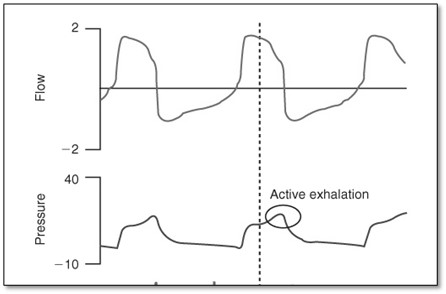 Illustration reference: OpenRN Respiratory Therapy Ch.5.1.
Common Errors
- Treating double triggering as random artifact → missed asynchrony correction opportunity.
- Ignoring pressure-drop trigger behavior → repeated breath stacking risk.
- Delayed escalation in persistent asynchrony → increased patient distress and ventilation inefficiency.
- Failing to reassess post-adjustment waveforms → unresolved mismatch can continue.
Related
- ventilator-waveform-interpretation - Core waveform skills are needed to identify asynchrony patterns.
- pressure-control-ventilation-monitoring - Trend monitoring helps detect mode-related mismatch and response to changes.