
Self-Harm and Suicide
Key Points
- Suicide risk is often linked to mental disorders, especially depression and substance-use conditions.
- Lethality assessment must evaluate intent, plan, means, timeline, prior attempts, and protective factors.
- Safety planning includes means restriction, monitoring level, therapeutic communication, and continuity workflows.
- Nonsuicidal self-injury (NSSI) differs in intent but is a strong predictor of future suicide risk.
- Universal suicide-risk screening in medical settings improves early detection and timely safety intervention.
- Adolescent self-harm prevalence is high in many cohorts (often reported around 17 to 60 percent), requiring routine direct screening.
- Inadequate or delayed suicide-risk assessment can cause severe safety failures and legal exposure.
Pathophysiology
Suicidality emerges from combined effects of emotional pain, hopelessness, cognitive constriction, impulsivity, and social disconnection. Mental illness and acute stressors can intensify this trajectory.
NSSI may temporarily regulate distress but can reinforce maladaptive coping and elevate later lethality risk.
Classification
- Suicidality continuum: Passive death wishes, active ideation, planning, attempt, and near-lethal behavior.
- Risk-context domains: Psychiatric diagnosis, substance use, hopelessness, impulsivity, social isolation, prior attempt or family history of suicide, major losses (relationship/job/financial), access to lethal means, and exposure to suicide in others.
- Expanded risk-factor set: Prior suicide attempt, chronic pain or serious medical illness, legal stressors, impulsive/aggressive tendencies, adverse childhood experiences, and violence victimization/perpetration history.
- Relationship-community-societal risk set: Bullying, loss of key relationships, social isolation, low health-care access, community violence, acculturation stress, historical trauma, discrimination, stigma against help-seeking, easy lethal-means access, and unsafe media portrayals of suicide.
- Self-harm domains: NSSI behaviors versus suicide-intent behaviors.
- NSSI behavior-pattern domain: Common methods include cutting/scratching, burning, self-hitting/head-banging, toxic ingestion/overdosing, and deliberate wound-healing interference.
- Adolescent-development risk context: Pubertal emotional lability, peer-influenced risk-taking, and identity distress can increase self-harm vulnerability.
- Adolescent high-risk profile cues: Female sex, only-child status, poor school performance, harsh parenting environment, and baseline mental-health burden can increase self-harm vulnerability.
- Protective-factor domains: Effective coping skills, reasons for living, social connectedness, and safe storage/reduced access to lethal means.
- Expanded protective-factor set: Strong cultural identity, school/community connectedness, and consistent access to high-quality physical and behavioral health services.
- System-safety domain: Structured suicide-prevention workflows include environmental risk assessment, validated ideation screening, risk stratification, safety planning, risk documentation/communication, discharge follow-up resources, and periodic protocol-effectiveness review.
- Method-risk domain: Common fatal methods vary by setting and access (for example firearms, hanging, and poisoning/overdose), so means-access review is mandatory in every lethality assessment.
Nursing Assessment
NCLEX Focus
Ask directly about suicide; direct questioning does not increase suicide risk and improves detection.
- Assess ideation intensity, intent, method, access to means, and timeline.
- Differentiate passive death wishes, active suicidal ideation, prior attempt history, and a current plan with available means and intent.
- Assess past attempts, self-harm history, and current protective factors.
- Treat protective factors as risk modifiers rather than proof of safety because some patients conceal suicidal distress or intent.
- Assess warning signs such as talking about wanting to die, feeling trapped/burdensome, seeking lethal methods, escalating substance use, agitation/recklessness, severe mood shifts, and social withdrawal.
- Assess acute crisis-pattern warning signs such as abrupt inability to perform basic ADLs, violent verbal threats/property destruction, loss of reality contact (psychosis), and paranoia.
- Treat abrupt mood change from prolonged depression to unexpected calm as a potential high-risk signal rather than automatic improvement.
- In major depression, treat sudden euphoric recovery with increased energy as a potential near-term attempt-risk window and escalate safety surveillance.
- If psychosis is present, ask whether hallucinations include commands to self-harm or harm others.
- Use universal suicide screening for clients age 12 years and older in medical settings per policy.
- Use a brief first-pass tool such as PSS-3 where available (depression, active suicidal ideation, lifetime suicide attempt), then escalate to comprehensive risk assessment when positive.
- In behavioral-health safety workflows, screen not only psychiatric inpatients but also clients treated for behavioral conditions in general-hospital/critical-access settings and any client who reports suicidal ideation during care.
- Use ASQ-style escalation logic when applicable: if any baseline item is positive or refused, ask current-ideation acuity question and classify acute versus non-acute positive risk.
- Use structured follow-up risk tools such as C-SSRS when available; evaluate ideation, plan specificity, intent, prior suicidal/self-harm behavior, and access to lethal methods.
- Use SAFE-T (Suicide Assessment Five-Step Evaluation and Triage) when available: identify risk factors, identify protective factors, conduct suicide inquiry (thoughts/plans/behavior/intent), determine risk level with intervention, and document rationale plus follow-up.
- In fast triage settings, use brief tools (for example SAD PERSONS) only as adjuncts; never replace full clinical judgment and reassessment.
- Repeat suicide-risk assessment at first contact and when suicidal behavior/ideation increases, pertinent clinical status changes occur, inpatient privileges increase, or discharge planning begins.
- Treat “current thoughts of killing self” as imminent-risk signal requiring immediate safety evaluation, continuous observation, environmental hazard removal, and urgent provider notification.
- Ask both wish-to-die and reasons-for-living questions to identify ambivalence that can be leveraged in safety planning.
- For positive but non-acute screens, complete brief suicide safety assessment and notify provider for disposition planning.
- Assess setting-specific environmental hazards and transition-period risks.
- Assess cultural context, stigma barriers, and help-seeking feasibility.
- For suspected NSSI, assess concealment patterns (for example long sleeves in warm weather), unexplained possession of sharps, repeated vague “minor injury” visits, and evasive explanations.
Nursing Interventions
- Initiate safety precautions based on structured and ongoing risk assessment.
- Build nonjudgmental therapeutic alliance and support disclosure.
- Normalize screening questions during introduction (“we ask everyone”) to reduce perceived intrusiveness and improve disclosure.
- Implement collaborative safety plan with crisis contacts and means-restriction steps.
- Prioritize safety plans over “no-harm” or “contract for safety” agreements alone; contracts do not reliably prevent suicide attempts.
- Implement 1:1 observation when indicated and adapt the environment before leaving the client alone (remove sharps, ligature-capable items, toxic-ingestion products, and unsecured equipment).
- For highest-risk periods, maintain continuous visual observation that can include personal-care periods (for example showering) per policy and dignity safeguards.
- Place the client in the least restrictive, safe, monitored setting that still matches current risk, and reassess suicide risk at least daily (or more often with status change) to titrate precautions.
- For moderate/lower-risk inpatients, use frequent, structured, and variably timed safety checks to reduce attempt opportunity.
- Complete environmental risk assessment actions for high-risk clients: remove potential self-harm objects, assess belongings brought by clients/visitors, and use safety-controlled transport workflows during internal movement.
- During medication administration, verify ingestion (for example mouth checks when indicated) and monitor for medication-hoarding behavior that could support later self-harm.
- In psychiatric environments, include ligature-risk mitigation such as reducing anchor points and unsafe fixtures where feasible under facility policy.
- Build safety-plan content explicitly: triggers/high-risk situations, preferred coping strategies, lethal-means restriction/transfer, trusted contacts with permission to involve them, and crisis resources.
- Keep safety plans brief, collaborative, and written in the client’s own words; identify likely use barriers, where the plan will be kept, and how it will be retrieved during crisis.
- Teach that suicidal intensity often rises, peaks, and then falls; use active coping and support activation to bridge the peak period safely.
- Provide crisis resources to all screened clients, including 988 Suicide & Crisis Lifeline and Crisis Text Line (text
HOMEto741741).
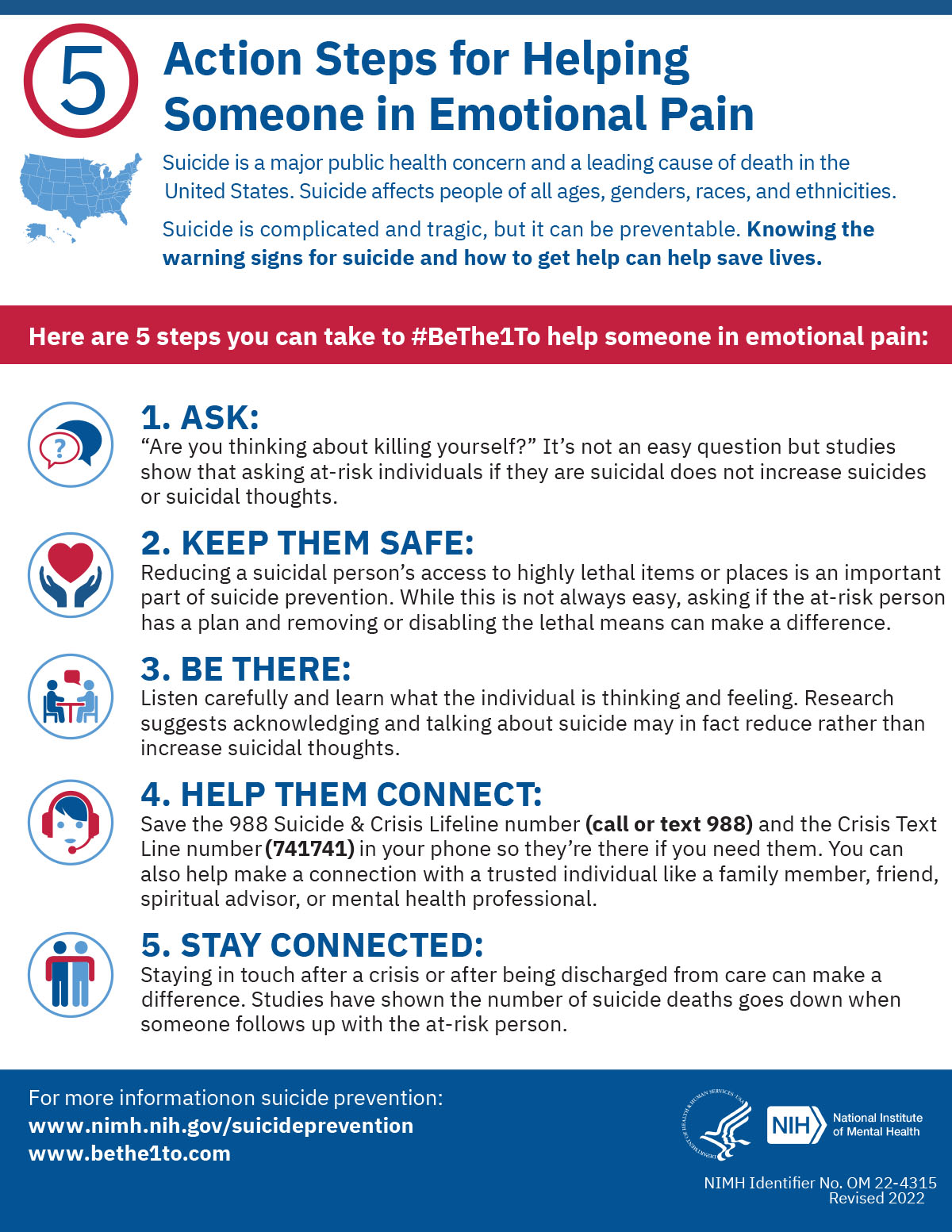 Illustration reference: OpenStax Clinical Nursing Skills Ch.20.1.
- If imminent self-harm danger is suspected in community or nonsecured settings, activate emergency response (for example 911), remain with the person or ensure continuous supportive supervision, and remove accessible lethal means until handoff occurs.
- Coordinate handoff quality at admission, transfer, and discharge transitions.
- Document risk level and safety interventions at least each shift (or more often with status change), communicate the active safety plan to the full team, and follow written agency suicide-prevention policy without exceptions.
- At discharge from high-risk settings (especially psychiatric inpatient or emergency care), provide written follow-up and crisis-contact information in addition to the safety plan, with family/support sharing as appropriate to consent and policy.
- Include family/support persons in discharge planning when appropriate: teach warning-sign recognition, review the recurring-thought emergency plan, confirm follow-up logistics, and verify that the client/caregiver can carry out outpatient treatment steps.
- Participate in periodic quality-review of suicide-prevention protocols (for example Zero Suicide-model workflows) to reduce recurrent system failures.
- After inpatient suicide events, support formal postvention (team/client debriefing and support pathways) to reduce contagion risk and strengthen system recovery.
- Address access barriers early (stigma, resource limitations, and referral delays) to reduce treatment drop-off after risk identification.
- Provide NSSI-focused coping-skill alternatives and emotion-regulation support.
Static-Risk Assumption
Suicide risk changes over time; one-time assessment without reassessment is unsafe.
Pharmacology
Medication can reduce core psychiatric symptoms but may shift energy before suicidality resolves. Nursing monitoring must track activation, adherence, hoarding risk, and early-treatment escalation needs, with increased surveillance after antidepressant initiation or dose increase.
Clinical Judgment Application
Clinical Scenario
A client with severe depression denies immediate intent but reports daily thoughts of death, stockpiling medications, and recent social withdrawal.
- Recognize Cues: Multiple high-risk lethality indicators are present despite denial of immediate intent.
- Analyze Cues: Means availability and behavioral changes increase near-term danger.
- Prioritize Hypotheses: Priority is immediate safety containment and intensive reassessment.
- Generate Solutions: Initiate precautions, remove means, and activate multidisciplinary suicide-prevention protocol.
- Take Action: Implement close observation and collaborative crisis plan.
- Evaluate Outcomes: Reassess intent, means access, and protective-factor stability frequently.
Related Concepts
- depressive-disorders - Major risk domain for suicidality and self-harm.
- bipolar-disorders - Includes elevated suicide risk across mood phases.
- violence-and-safety - Aligns safety management for self-directed and interpersonal risk.
- trauma-informed-care - Supports non-coercive care in high-distress states.
- continued-support - Reinforces post-discharge suicide-risk continuity planning.