
Opioid Use Disorder
Key Points
- OUD can begin with prescribed analgesics or illicit opioid use and progresses through tolerance, dependence, and compulsive use.
- The opioid overdose triad is pinpoint pupils, respiratory depression, and decreased level of consciousness.
- Naloxone rapidly reverses opioid effects but requires ongoing monitoring because rebound toxicity can occur.
- Sustained recovery usually requires medication-assisted treatment plus behavioral and social support.
- In justice-involved populations, access to medications for OUD during incarceration and at release reduces relapse and post-release overdose mortality.
Pathophysiology
Opioids bind central opioid receptors involved in analgesia and reward. Core receptor families (mu, delta, and kappa) are activated by endogenous opioid peptides (for example endorphins) and exogenous opioids. Repeated exposure causes tolerance, then physiologic dependence, so abrupt cessation triggers withdrawal symptoms and intense craving.
In OUD care, dependence is not the same as tolerance: dependence indicates withdrawal with dose reduction or cessation, while tolerance reflects reduced response that requires higher doses to reach similar effects.
As use escalates, intoxication and respiratory suppression risk increase, especially with fentanyl-contaminated supply or polysubstance use. Reduced tolerance after abstinence sharply increases overdose risk during relapse.
Classification
- Prescription opioid misuse: Overuse, non-prescribed use, or diversion of opioid analgesics.
- Illicit opioid use: Heroin and nonmedical synthetic opioids.
- Epidemiologic surge context: U.S. overdose mortality rose in three waves linked to prescription-opioid misuse (1990s), heroin (around 2010), and synthetic opioids such as illicit fentanyl (from around 2013).
- Receptor-system context: Mu, delta, and kappa receptor signaling drives both analgesic and reward effects linked to misuse progression.
- Complicated OUD: OUD with injection-related infection, social destabilization, or repeated overdose.
- Diagnostic threshold context: OUD diagnosis requires at least two DSM-5 symptom criteria within a year.
Nursing Assessment
NCLEX Focus
In suspected overdose, assess airway and respiratory status first, then neurologic status and exposure history.
- Assess opioid type, route, last use, and prior overdose history.
- If toxicology results are discordant with symptoms, remember routine urine opioid screens may miss some synthetic opioids (for example selected fentanyl or oxycodone pathways) unless specific assays are ordered.
- Assess pregnancy status and perinatal risk because opioid exposure in pregnancy is linked with miscarriage, low birth weight, and neonatal abstinence syndrome.
- In unresponsive presentations, attempt loud verbal and physical stimulation (for example, sternal-rub knuckle pressure) while preparing emergency escalation.
- Assess intoxication findings: miosis, sedation, dysarthria, impaired attention, respiratory depression.
- Assess additional intoxication cues such as drowsiness/coma, slurred speech, and impaired attention or memory.
- Assess for high-potency synthetic-opioid exposure risk (for example fentanyl analog contamination) and use PPE/scene-safety precautions if powder contact or inhalation exposure is possible.
- Assess for injection-related harms (track marks, skin infection, HIV/HBV/HCV risk).
- Assess route-specific complication patterns: snorting can cause nasal septal perforation, and injection use increases risk for sepsis, gangrene, and infective endocarditis.
- Screen for systemic complications in ongoing illicit use, including stroke, seizures, chronic cardiac dysfunction, psychosis, cognitive decline, and rhabdomyolysis.
- Assess withdrawal severity with COWS or CINA at protocol intervals; COWS tracks 11 withdrawal signs/symptoms with severity scaling.
- Assess opioid-withdrawal symptom clusters (for example sweating, confusion, mydriasis, appetite loss, diarrhea/vomiting, cramps, tremor, yawning, and flu-like symptoms) and trend change over time.
- Assess detoxification context and goals (for example hospitalization without opioid access, transition to MAT, or abstinence requirements tied to legal/residential settings).
- Assess correctional-status transitions (incarceration, pending release, probation/parole) because abrupt treatment interruption after custody increases overdose risk.
- Assess key risk domains: first-degree family history of substance disorder, prior opioid exposure after injury, peer use, and comorbid depression/PTSD/anxiety or childhood trauma.
- Assess readiness for change, treatment preference, and discharge barriers.
Nursing Interventions
- Activate emergency response when stimulation fails and provide rescue breathing/oxygen or compressions as indicated.
- Administer naloxone (intranasal, intramuscular, subcutaneous, or intravenous) for suspected opioid overdose, including in pregnancy.
- Counter undertreatment bias: use naloxone for suspected overdose in women, older adults, and clients without obvious OUD history/signs.
- Repeat naloxone in 2 to 3 minutes if response is inadequate; potent or long-acting opioids (for example fentanyl) may require additional IV bolus doses or infusion.
- Continue resuscitation while waiting for naloxone effect; the immediate target is restoration of adequate spontaneous breathing, not full arousal.
- Anticipate naloxone-precipitated withdrawal (confusion, agitation, aggression) and maintain safety with brief reassurance and reorientation.
- Monitor for recurrent sedation/respiratory depression because naloxone duration is shorter than many opioids.
- Continue monitoring for recurrent opioid toxicity for at least 4 hours after the last naloxone dose; prolonged monitoring is needed for long-acting or potent opioids (for example fentanyl).
- Transfer to definitive emergency care even after apparent early revival.
- Initiate detox symptom management and transition planning for ongoing treatment.
- Before initiating naltrexone or buprenorphine-naloxone, verify most recent opioid use timing to reduce precipitated-withdrawal risk.
- During withdrawal care, provide a calm low-stimulation environment and monitor dehydration risk from vomiting, diarrhea, or diaphoresis with oral/IV fluid support as indicated.
- For pregnant clients, coordinate obstetric and neonatal planning early because fetal and maternal outcomes depend on sustained treatment engagement.
- Start buprenorphine-based withdrawal treatment when objective withdrawal is present (commonly COWS greater than 10) to reduce precipitated withdrawal risk; initial doses are often 2-4 mg sublingual per protocol.
- Support balanced pain-care communication that weighs opioid benefits and risks while reducing overdose risk.
- Match post-detox treatment intensity to need and access (outpatient counseling, intensive outpatient, short-term residential, long-term therapeutic community/sober-living, and MAT).
- Provide harm-reduction education and linkage to community recovery resources.
- Link clients to structured peer recovery support (for example Narcotics Anonymous) alongside counseling and medication follow-up.
- In justice-involved pathways, coordinate pre-release MOUD continuation/initiation planning and confirm warm handoff to outpatient addiction treatment.
- Emphasize overdose-prevention touchpoints (bystander training, post-institution-release risk counseling, prior-overdose follow-up, and naloxone access) because relapse after abstinence carries sharply increased mortality risk.
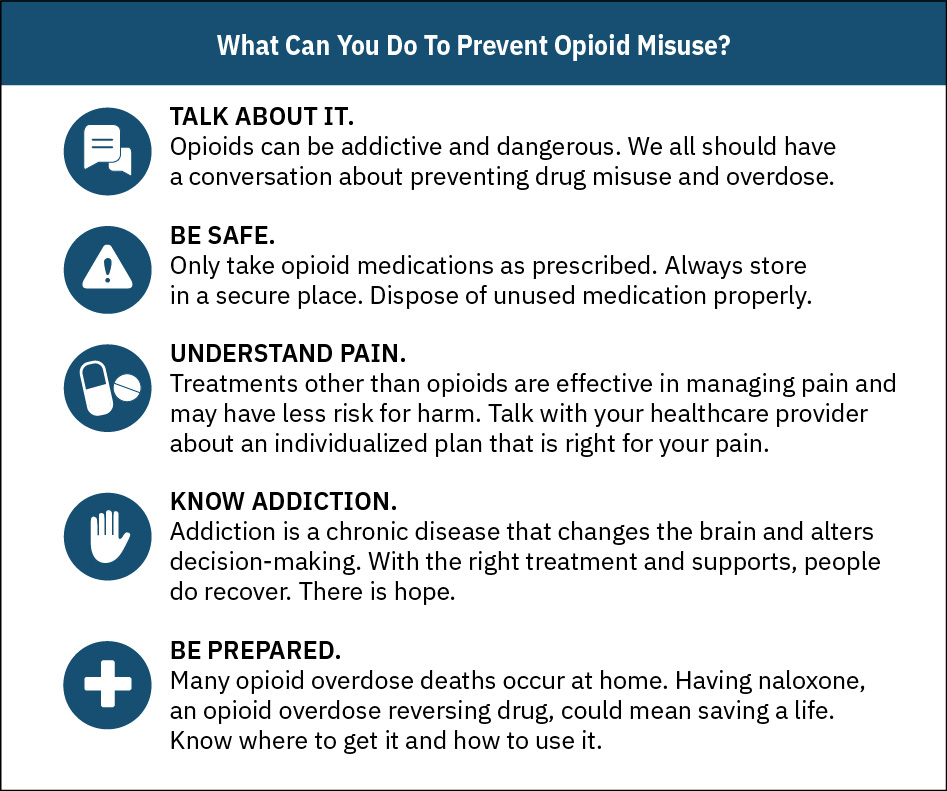 Illustration reference: OpenStax Psychiatric-Mental Health Nursing Ch.19.4.
Recurrent Toxicity Risk
Naloxone can wear off before the opioid clears; continuous reassessment is mandatory.
Pharmacology
FDA-approved medications for OUD include buprenorphine-naloxone, methadone, and naltrexone. Buprenorphine-naloxone (Schedule III) is used for detoxification or maintenance, methadone (Schedule II) is used for withdrawal and long-term maintenance and is dispensed for OUD through SAMHSA-certified and state-approved opioid treatment programs, and naltrexone is not scheduled and blocks opioid euphoria.
Evidence supports MOUD use in correctional settings; withholding methadone, buprenorphine, or naltrexone when clinically indicated increases relapse and post-release overdose risk.
Extended-release naltrexone injections can support relapse prevention adherence in selected clients.
Naltrexone initiation generally follows an opioid-free interval (commonly about 5-7 days) to reduce immediate antagonist-precipitated withdrawal.
Buprenorphine-naloxone uses buprenorphine as a partial mu-agonist to reduce withdrawal/craving, while naloxone in combined oral/sublingual products acts mainly as abuse deterrence if injected. Because buprenorphine has high receptor affinity and can displace full agonists, induction is usually timed to objective early-withdrawal onset.
Methadone’s long half-life (up to about 59 hours) supports withdrawal suppression but also requires cautious accumulation monitoring, direct-observed-dosing workflows in OUD programs, and QTc surveillance when other QT-prolonging risks are present.
In the United States, naloxone nasal spray became available over the counter in March 2023, improving bystander-access pathways for overdose rescue.
Targeted symptom-relief medications may be used for anxiety/restlessness, GI upset, insomnia, and musculoskeletal discomfort during withdrawal; alpha-2 adrenergic agonists such as clonidine or lofexidine can reduce autonomic withdrawal symptoms. Monitor clonidine-related hypotension and sedation closely and avoid use when contraindications are present (for example significant hypotension, renal insufficiency, cardiac instability, pregnancy, or psychosis). Avoid routine benzodiazepine or zolpidem co-use with methadone/buprenorphine unless closely supervised due to oversedation risk.
Nurses support medication initiation, monitor adverse effects, and reinforce adherence and overdose-prevention planning. Medication should be paired with behavioral treatment and social support for best outcomes.
Clinical Judgment Application
Clinical Scenario
An unresponsive client is found with shallow respirations, pinpoint pupils, and cyanotic lips.
- Recognize Cues: Classic opioid overdose triad with hypoventilation.
- Analyze Cues: Immediate risk is hypoxic arrest from respiratory failure.
- Prioritize Hypotheses: Stabilize airway/breathing and reverse opioid effect.
- Generate Solutions: Call emergency team, ventilatory support, naloxone administration.
- Take Action: Deliver naloxone and reassess respiratory rate and consciousness.
- Evaluate Outcomes: Confirm return of adequate ventilation and arrange definitive monitoring/treatment.
Related Concepts
- substance-use-disorders - Broader framework for dependence and relapse.
- dealing-with-addiction - Expands MAT, withdrawal, and continuum-of-care planning.
- alcohol-use-disorder - Highlights cross-substance withdrawal and safety differences.
- stimulant-use-disorders - Contrasts overdose and withdrawal management approaches.
- emergency-situations-and-rapid-response - Supports urgent stabilization workflow.