
PDSA Cycle for Nursing Quality Improvement
Key Points
- PDSA is an iterative quality-improvement cycle used to test and refine practice changes.
- Four steps are Plan, Do, Study, and Act.
- Baseline and post-change data comparison drives decisions.
- Cycles repeat until a reliable, sustainable improvement is achieved.
- Before the cycle, define the three improvement-model questions: aim, evidence of improvement, and candidate change.
- Define a numeric aim and metric early (for example fall rate per 1,000 patient days with a one-year target).
- Pair goals with SMART framing and include outcome, process, structure, and balancing metrics.
- In the Act phase, teams explicitly review barriers, strengths, and needed adjustments before the next cycle.
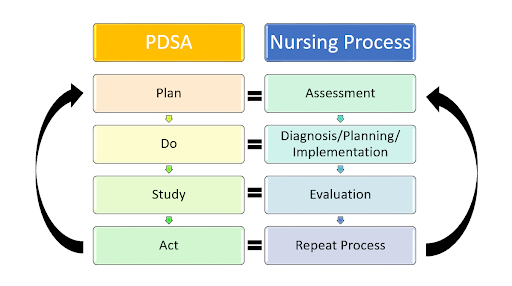 Illustration reference: OpenRN Nursing Management and Professional Concepts 2e Ch.9.3.
Equipment
- Defined improvement target and measurable indicators
- Baseline data collection template
- Post-intervention audit/trending tool
- Stakeholder map and communication plan
Procedure Steps
- Confirm the three pre-cycle questions: target aim, measurement plan, and expected change mechanism.
- Plan: Define the problem, SMART goal, metrics, stakeholders, and a small-scale intervention.
- Collect baseline performance data before implementing the change.
- Include at least one balancing metric to monitor unintended harm while improving the target outcome.
- Do: Run the intervention in a controlled test period.
- Capture process and outcome data during the test.
- Study: Compare observed results with expected targets.
- Identify barriers, unintended effects, and fidelity gaps.
- Act: Decide to adopt, adapt, or abandon the tested change.
- Review team strengths and weaknesses from implementation and use that analysis to revise the intervention plan.
- Launch the next PDSA cycle with revised plan parameters as needed.
- Continue sequential cycles until improvement is stable and reproducible.
Common Errors
- Skipping baseline data → cannot prove change effect.
- Testing too many variables at once → unclear causal interpretation.
- Acting without Study analysis → repeated ineffective cycles.
- Stopping after one successful test → poor long-term sustainment.
Related
- quality-improvement-nurse-role-and-qapi - Organizational context for QI cycle deployment.
- quality-assurance-and-donabedian-model-in-nursing-evaluation - Framework for evaluating improvement dimensions.
- documenting-risk-management-and-intervention-evaluation - Documentation inputs used in cycle analysis.