
Quality Improvement Nurse Role and QAPI
Key Points
- QI is a continuous system for reducing errors and improving outcomes.
- Core QI design starts with three questions: aim, measure of improvement, and change strategy.
- QI nurses support data-driven quality efforts across units and organizational levels.
- QSEN quality-improvement competency emphasizes outcome-data monitoring and iterative testing of process/policy changes.
- QA provides oversight for maintaining current standards.
- QA emphasizes compliance with minimum standards, while continuous quality improvement focuses on improving interrelated processes and outcomes.
- QAPI combines QA and performance improvement in post-acute care settings.
- QI programs commonly target patient experience, team performance, and data-guided decision-making in parallel.
- Standardized patient-experience measurement (for example HCAHPS in U.S. hospitals) supports transparency and reimbursement-linked quality incentives.
- Safety-event learning distinguishes never events, sentinel events, and near misses, then applies RCA and human-factors analysis to prevent recurrence.
- Healthcare quality reflects whether care reliably improves outcomes in ways consistent with current evidence and standards.
- AHRQ quality domains (safe, effective, patient centered, timely, efficient, equitable) provide a practical target map for QI outcome design.
- Root-cause findings should separate system defects from isolated competency gaps so actions can combine redesign with targeted retraining.
- Frontline nurse engagement in QI improves resource use and supports practical innovation in workflows.
- QI improves existing local care processes, whereas research seeks new and generalizable nursing knowledge.
- Common QI barriers include change resistance, weak data systems, resource constraints, unsupportive culture, and policy/regulatory limits.
- Underreporting driven by shame/blame culture weakens learning loops and allows preventable obstetric errors to recur.
- The Model for Improvement combines three aim questions with iterative PDSA testing, typically using SMART goals and mixed metric types.
- IHI Triple Aim aligns improvement work to three concurrent targets: better care experience, better population health, and lower per-capita cost.
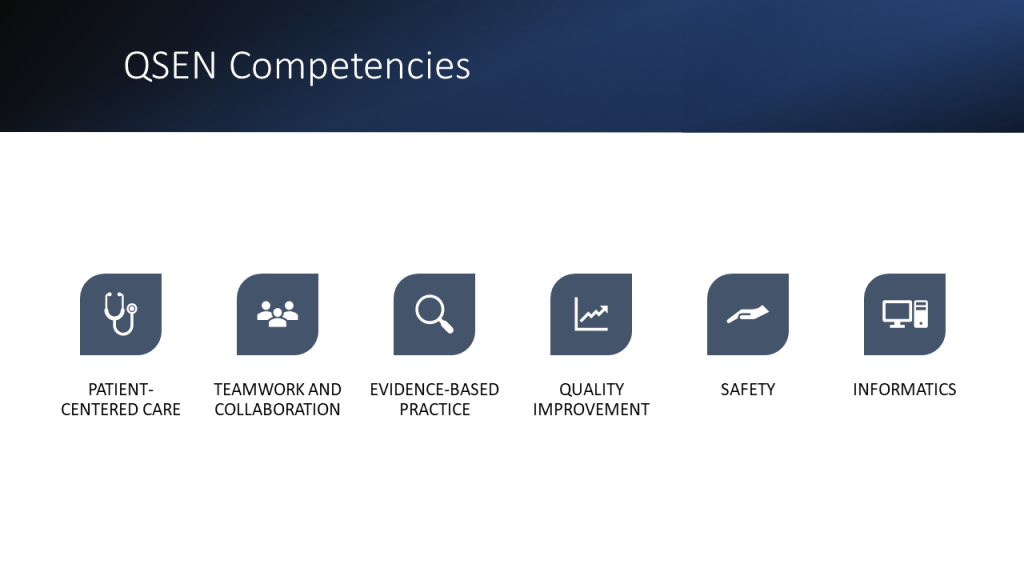 Illustration reference: OpenRN Nursing Management and Professional Concepts 2e Ch.10.7.
Pathophysiology
Patient harm events often arise from repeatable process weaknesses. QI frameworks reduce variation, identify trend-based hazards, and implement structured interventions to lower preventable adverse-event burden.
Classification
- QI nurse role: Leads or supports systemwide quality initiatives, data review, and implementation support.
- Quality assurance (QA): Oversight to maintain standards through audits, education, and support.
- QAPI: Integrated QA + performance improvement framework mandated in post-acute settings.
- QI initiatives: Lean, PDSA, and competency-based quality culture programs.
- QI model-origin domain: Six Sigma (Motorola) prioritizes variation/defect reduction, while Lean (Toyota) prioritizes waste elimination and efficiency.
- Patient-focused QI domain: Improves patient experience, communication quality, and preference-aligned care delivery.
- Team-focused QI domain: Strengthens interdisciplinary coordination, role clarity, and collaborative reliability.
- Data-focused QI domain: Uses trend analysis and outcome tracking to select and test improvement priorities.
- PDSA cycle: Plan, Do, Study, and Act loop used for rapid iterative testing and improvement scaling.
- Three-question improvement model: Defines what to accomplish, how improvement will be measured, and which change is most likely to improve outcomes.
- Model-for-Improvement phase domain: Phase 1 sets aims/measures/change selection; Phase 2 tests and refines change through PDSA.
- QI metric-type domain: Outcome, process, structure, and balancing metrics are used together to track intended benefit and unintended harm.
- QI-versus-research distinction: QI optimizes current processes in a specific setting; research generates new and generalizable evidence.
- QI barrier domain: Resistance to change, fragmented data systems, staffing/financial/time limits, weak improvement culture, and regulatory constraints.
- QSEN-aligned quality education: Integration of quality and safety competencies into prelicensure and ongoing nursing practice.
- AHRQ six-domain quality framework: Care-quality targets spanning safe, effective, patient-centered, timely, efficient, and equitable performance.
- Never-event accountability: Preventable, serious adverse events that trigger public reporting and strong system-level correction.
- Sentinel-event response: Severe harm/death events requiring immediate investigation and organizational response.
- Near-miss learning: Intercepted or chance-avoided errors analyzed to prevent future harm.
- RCA and human-factors integration: Multidisciplinary system analysis that avoids individual blame and targets process/tool/environment contributors.
- Error-of-omission domain: Missed assessments, delayed monitoring, incomplete documentation, and delayed response are tracked as high-risk quality failures.
- Interruption-related medication-safety domain: Preparation and documentation interruptions are monitored because they increase medication-error risk.
- Root-cause action branch: System-level failures trigger process redesign; isolated competency failures trigger retraining and reassessment.
- Lean waste-reduction focus: Removal of non-value tasks (for example duplicate steps, excess motion, and inefficient role use) to increase bedside care time.
- Quality-organization support ecosystem: Practice guidance from ANA, AHRQ, The Joint Commission, Magnet standards, and NCCMERP medication-safety policy work.
- Patient satisfaction programs: Structured feedback systems (surveys, interviews, advisory channels) used to improve service quality.
- HCAHPS program: U.S. standardized hospital patient-experience survey used for public reporting and value-based payment linkage.
- Triple-Aim target set: Improve care experience/quality-satisfaction, improve population health outcomes, and reduce per-capita cost.
- Triple-Aim implementation components: Focus on individuals/families, redesign primary-care structures, strengthen population-health management, establish cost-control platform, and execute integrated system governance.
Nursing Assessment
NCLEX Focus
QI starts with measurable problem definition and baseline data before intervention.
- Identify high-risk trends in errors, adverse events, and near misses.
- Classify serious events as never-event, sentinel-event, or near-miss patterns to guide response urgency.
- Evaluate process reliability and barriers to standard practice.
- Define baseline metrics before intervention rollout.
- Assess barrier load before launch (staff readiness, data infrastructure, available time/budget, leadership support, and regulatory constraints).
- Assess whether project teams can distinguish local process-improvement goals from formal research goals.
- Assess whether staff competency/resources align with quality targets.
- Reassess outcomes after interventions for sustainment planning.
- Assess which AHRQ quality domain(s) each project is targeting and whether metrics are mapped to those domains.
- Assess whether defects are primarily system design failures or isolated competency/performance gaps.
- Assess workflow waste patterns (duplicate tasks, avoidable transport/motion, or under-license role use) that reduce direct-care time.
- Assess whether nurses and students are participating in gap identification and frontline improvement efforts.
- Assess patient-experience signals (communication quality, discharge understanding, and responsiveness) as formal QI inputs.
- Assess whether teams are using patient, team, and operational data together rather than relying on one metric stream.
- Assess for underreporting patterns linked to fear, shame, or punitive response after adverse events.
Nursing Interventions
- Participate in unit and system quality projects using structured QI methods.
- Use data feedback to prioritize high-impact process changes.
- Start each project with explicit aim, outcome measure, and change hypothesis using the three QI model questions.
- Set SMART aims and pair them with outcome/process/structure/balancing metrics before implementation.
- Use incident/variance-report data to detect latent safety defects and process instability.
- Collaborate across disciplines for implementation and sustainment.
- Build patient-feedback capture channels (for example surveys, suggestion pathways, and structured feedback sessions) into improvement cycles.
- Run PDSA loops with explicit plan targets, pilot execution, outcome-study checkpoints, and action-stage standardization or revision.
- Address resistance with transparent communication, role-specific training, and visible frontline feedback loops.
- Strengthen data infrastructure so teams can collect and review outcomes in real time.
- Conduct multidisciplinary root cause analyses for severe events and apply human-factors findings to redesign workflows.
- Use root cause analysis before solution selection so interventions target process causes rather than symptoms.
- Build nonpunitive reporting pathways and disclosure-support training so teams report obstetric near misses and adverse events consistently.
- Use multidisciplinary rounding as a shared-governance QI tactic when satisfaction and device-utilization metrics (for example central-line and catheter days) need improvement.
- Map every QI project to explicit quality-domain targets and measurable outcomes before launch.
- Use Lean reviews to remove non-value workflow steps and return nursing time to direct patient care.
- If RCA shows a role-specific competency gap, implement targeted retraining with defined reassessment checkpoints.
- Recommend policy, staffing, or equipment changes when trends indicate need.
- Build culture of continuous improvement through ongoing education.
- Frame QI work as a shared responsibility across clinicians, patients/families, educators, and system stakeholders.
- Use patient-satisfaction programs (including advisory councils where available) to co-design communication, comfort, and discharge improvements.
- In hospital settings, track HCAHPS-aligned domains and convert weak domains into targeted improvement plans with ownership and remeasurement.
- Use external quality resources (for example AHRQ toolkits and TeamSTEPPS, Joint Commission safety goals, Magnet expectations, and NCCMERP medication-safety guidance) when designing interventions.
- Implement interruption-reduction workflows for medication preparation/management/documentation and measure their effect on error trends.
- For population-level redesign work, use Triple-Aim implementation components to align local project portfolio, measurement plan, and system-integration strategy.
Improvement Drift Risk
Early gains can reverse if outcome monitoring and sustainment planning stop after initial success.
Pharmacology
Medication safety QI can target administration errors, treatment delays, and follow-up failures through process redesign and monitoring.
Clinical Judgment Application
Clinical Scenario
A facility identifies recurring treatment delays linked to preventable adverse events.
- Recognize Cues: Error trend and patient-harm signal are present.
- Analyze Cues: System-level process gap likely contributes to repeated failures.
- Prioritize Hypotheses: Data-guided intervention is needed rather than isolated retraining.
- Generate Solutions: Launch QI cycle with baseline metrics and targeted workflow changes.
- Take Action: Implement interventions and monitor adherence/outcomes.
- Evaluate Outcomes: Event rates decrease and process reliability improves.
Related Concepts
- quality-assurance-and-donabedian-model-in-nursing-evaluation - Foundational quality-evaluation framework.
- ihi-evidence-based-practice-bundles - Example of reproducible evidence-based quality strategy.
- documenting-risk-management-and-intervention-evaluation - Documentation inputs used for QI trend analysis.
Self-Check
- How does QAPI differ from standalone QA?
- Why are baseline metrics essential before implementing quality changes?
- What roles do bedside nurses and QI nurses share in sustainment?