
Arterial Blood Gas (ABG)
| Test | Normal Range | Critical Values |
|---|---|---|
| pH | 7.35-7.45 | <7.25 or >7.60 |
| PaO2 | 80-100 mm Hg | <60 mm Hg |
| PaCO2 | 35-45 mm Hg | <25 mm Hg or >60 mm Hg |
| HCO3- | 22-26 mEq/L | <10 mEq/L or >40 mEq/L |
| Base excess/deficit | -2 to +2 mEq/L | Persistent base deficit suggests metabolic acidosis burden |
| SaO2 | 95-98% | <88% |
Clinical Significance
NCLEX Pattern
ABG questions usually test rapid recognition of which value is outside range, whether the disorder is respiratory or metabolic, and which finding requires immediate escalation.
ABGs are commonly ordered when respiratory distress is present and oxygenation/ventilation status needs rapid objective clarification.
High-Risk Acidemia
A pH near 7.10 can be rapidly fatal and requires urgent escalation and cause-directed treatment.
PaO2 is often a more accurate oxygenation indicator than SaO2 when respiratory status is unstable.
Rapid Interpretation Steps
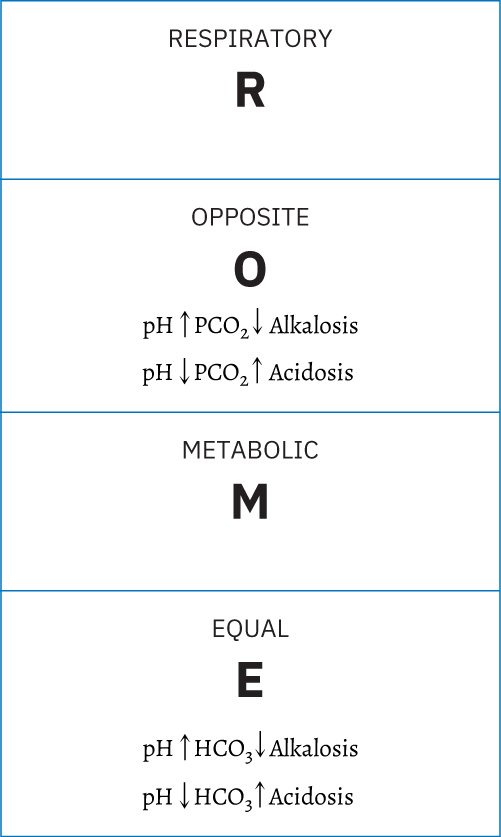 Illustration reference: OpenStax Fundamentals of Nursing Ch.20.2.
- Determine acidemia or alkalemia from pH.
- Check PaCO2 to evaluate respiratory direction (
ROME: respiratory opposite pH). - Check HCO3- to evaluate metabolic direction (
METabolic EqualpH direction). - Classify compensation: uncompensated, partially compensated, or fully compensated using pH recovery and PaCO2/HCO3 trends.
Elevated PaCO2
- Indicates: respiratory-acidosis, hypoventilation-related carbon dioxide retention
- Nursing action: assess respiratory rate and work of breathing, notify provider, and support ventilation strategy
Decreased PaCO2
- Indicates: respiratory-alkalosis, excessive ventilation with carbon dioxide loss
- Nursing action: evaluate cause of hyperventilation and reassess serial blood gases
Elevated HCO3-
- Indicates: metabolic-alkalosis
- Nursing action: review fluid status and causes of hydrogen ion loss, then trend follow-up chemistry and ABG values
Decreased HCO3-
- Indicates: metabolic-acidosis
- Nursing action: assess renal function and perfusion, then monitor trend response to treatment
Related Labs
- basic-metabolic-panel - Provides bicarbonate and other electrolyte context for ABG interpretation.
- serum-potassium - Potassium shifts often accompany acid-base disturbances.
- serum-sodium - Sodium and water balance can influence overall fluid and acid-base status.