
Environmental Health Foundations and Nursing Practice
Key Points
- Environmental health examines how natural and built environments influence disease, disability, and mortality.
- Core public-health gains from sanitation, safe water, and lead-risk reduction show that environmental interventions can produce population-scale health improvement.
- Environmental hazards are inequitably distributed, with higher burden often concentrated in lower-income and structurally marginalized communities.
- Environmental exposure pathways include air, water, food systems, housing conditions, and climate-linked extreme events.
- Climate-driven heat, wildfire smoke, and vector-range expansion increase cardiopulmonary, infectious, and mental-health risk.
- Human-driven warming has accelerated into an Anthropocene pattern marked by large-scale and partly irreversible ecosystem disruption.
- Oceans currently buffer climate change by absorbing substantial heat and carbon, but warming and acidification reduce this protection and increase sea-level/storm risk.
- Climate pressure on food systems lowers yield stability and nutritional quality, increases price volatility, and amplifies food insecurity risk.
- Climate-linked physical-health burden includes increased heat-related illness/death, cardiopulmonary exacerbations, renal/electrolyte injury, and adverse pregnancy outcomes.
- Climate-linked mental-health burden includes anxiety, depression, PTSD, substance-use escalation, suicide-risk worsening, and climate-specific distress patterns.
- Nursing practice includes exposure-risk identification, prevention teaching, interprofessional collaboration, and equity-focused advocacy.
- Environmental-health integration in nursing practice should use hierarchy-of-controls logic plus public-health core functions (assessment, policy development, assurance).
- Nurses are high-trust climate-health messengers and can drive community resilience planning through education, partnerships, and policy advocacy.
- Nightingale’s environmental framework remains clinically relevant: clean air, clean water, sanitation, hygiene, and light are foundational care conditions.
- One Health connects human, animal, and environmental systems and is central to zoonotic-risk prevention and food-water safety planning.
- Environmental-health planning should combine upstream action on root causes with downstream mitigation for current illness burden.
- Environmental-justice practice requires fair protection from hazards and meaningful community involvement in policy and regulatory decisions.
- Exposure assessment, toxicology, environmental epidemiology, and biomonitoring support risk quantification and targeted intervention design.
- Environmental burden evaluation includes cumulative impacts and bioaccumulation risk, especially in already vulnerable communities.
- Environmental agents are commonly grouped as biological, chemical, and physical hazards with distinct exposure pathways and injury patterns.
- Priority toxic-exposure categories include teratogens, carcinogens, mutagens, neurotoxins, and endocrine-disrupting chemicals.
- Air-pollution nursing triage should integrate particulate matter, ozone, and nitrogen dioxide risk with AQI-based behavior guidance.
- Water-pollution risk includes persistent lead exposure; no level of lead in drinking water is considered safe.
- Land-pollution prevention includes hazardous-site remediation pathways (for example Superfund and Brownfields programs) plus safe waste and land-use controls.
- Client teaching should include PFAS-risk reduction in cookware, food packaging, water filtration, and dust control.
- Community right-to-know frameworks support public access to chemical-release information and emergency planning for toxic-hazard events.
- Population protection requires cross-sector coordination among health systems, public health, engineering, planning, and policy institutions.
- Environmental-health assessment combines pollutant measurement, risk assessment/management, and individual-home-community level evaluation.
- Public-health nursing roles include ensuring pollutant monitoring follow-through, public communication of findings, and concern escalation.
- EPA risk assessment uses four steps: hazard identification, dose-response, exposure assessment, and risk characterization.
- Environmental decision-making under uncertainty can use the precautionary principle to prevent harm before definitive causal proof is complete.
- I PREPARE is a nurse-developed individual environmental assessment mnemonic used to structure exposure history, referrals, and education.
- Home and community assessments should combine hazard mapping with asset mapping (for example parks and open spaces) and targeted support for vulnerable groups.
Pathophysiology
Environmental health risk accumulates when hazardous agents or unsafe living conditions increase human exposure over time. Disease burden rises as exposure frequency, intensity, and vulnerability overlap, especially when prevention infrastructure is weak.
In public-health nursing, environmental risk is managed as a prevention system: identify hazards early, reduce exposure, and strengthen protective conditions before downstream illness becomes entrenched.
Classification
- Environmental-health scope domain: Human health effects from natural and built environments.
- Healthy-environment condition domain: Clean air, stable climate, safe water, sanitation, safe chemical handling, radiation protection, safe workplaces, healthy built environments, and preserved ecosystems.
- Exposure-pathway domain: Airborne, waterborne, food-system, housing, and occupational pathways.
- Climate-linked hazard domain: Heat, wildfire, extreme weather, vector expansion, and related mental-health strain.
- Anthropocene domain: Current climate era shaped by accelerated human-driven environmental change with escalating population-health consequences.
- Ocean-buffer and acidification domain: Ocean heat/CO2 absorption that slows warming while simultaneously increasing acidification, sea-level, and marine-ecosystem stress.
- Food-system disruption domain: Climate-linked crop, fisheries, and supply-chain instability that increases food insecurity and nutrition-quality decline.
- Climate-sensitive infectious-risk domain: Shifting vector range/seasonality plus warmer-water pathogen growth (for example Vibrio risk expansion).
- Climate-mental-health domain: Psychological harm spectrum from chronic stress to anxiety, depression, PTSD, and climate-specific grief/distress syndromes.
- Vulnerability-triad domain: Climate risk determined by exposure intensity, biologic/social sensitivity, and adaptive capacity.
- Adaptation-planning domain: Early warning systems, resilient infrastructure, and water-management planning to reduce harm from projected events.
- Green-infrastructure domain: Nature-based urban design (for example green roofs, permeable surfaces, urban forests) used for heat, stormwater, air-quality, and co-benefit health mitigation.
- Hierarchy-of-controls domain: Exposure prevention strategy prioritizing source/environment controls before relying on individual behavior-only measures.
- Public-health core-functions domain: Environmental-health action organized through assessment, policy development, and assurance.
- Environmental-equity domain: Unequal hazard distribution driven by structural and policy determinants.
- Nursing environmental-role domain: Population assessment, risk communication, prevention counseling, and referral/advocacy actions.
- Nightingale environmental-theory domain: Recovery support through environmental optimization (air, water, sanitation, hygiene, light).
- Data-translation domain: Use of interpretable population data visualization to drive policy and practice change.
- One-Health domain: Integrated human-animal-environment approach for zoonotic, vector-borne, food-water safety, and antimicrobial-resistance threats.
- Upstream-intervention domain: Root-cause prevention through policy, regulation, infrastructure, and social-environmental change.
- Downstream-intervention domain: Illness mitigation through screening, treatment, and individual behavior support after exposure has occurred.
- Environmental-justice domain: Equitable hazard protection and meaningful participation of affected communities in environmental decision-making.
- Exposure-assessment domain: Characterization of frequency, intensity, duration, and route of agent contact in exposed populations.
- Toxicology domain: Evaluation of harmful-substance entry, metabolism, organ effects, and risk profile.
- Environmental-epidemiology domain: Population-level linkage of exposures to outcomes for prevention and policy action.
- Biomonitoring domain: Measurement of contaminants in biologic samples to track exposure burden and intervention effectiveness.
- Environmental-burden domain: Population impact estimation using morbidity, mortality, and DALY-oriented indicators.
- Cumulative-impact domain: Combined harm from pollution, social disadvantage, and preexisting disease.
- Bioaccumulation domain: Progressive contaminant buildup in organisms and food chains when elimination is slower than intake.
- Environmental-agent class domain: Biological, chemical, and physical agents that can generate environmental health hazards.
- High-priority toxin domain: Teratogens, carcinogens, mutagens, neurotoxins, and endocrine disruptors with life-stage-specific harm patterns.
- Microplastic-nanoplastic domain: Small-plastic pollutants with cross-media spread (air/water/soil/food) and potential tissue-barrier penetration risk.
- Air-pollution exposure domain: Particulate matter, ozone, and nitrogen dioxide exposure associated with respiratory, cardiometabolic, and neurologic harm.
- AQI risk-communication domain: Color-coded public alert system for ground-level ozone, particulate matter, carbon monoxide, sulfur dioxide, and nitrogen dioxide.
- Water-pollution domain: Industrial/agricultural/urban runoff contaminants with high concern for lead and other persistent toxicants.
- Lead-exposure domain: Developmental and neurologic toxicity risk, with heightened pediatric vulnerability and drinking-water pathway concern.
- Land-pollution domain: Soil contamination from waste disposal, industry, and agriculture with long-term food-chain and ecosystem effects.
- Hazard-site-remediation domain: Regulatory remediation and redevelopment pathways for contaminated sites (for example Superfund and Brownfields).
- PFAS exposure domain: Persistent fluorinated compounds linked to food packaging, cookware, household dust, and water-exposure pathways.
- Right-to-know domain: Community access to hazardous-chemical presence/release data and emergency-planning information.
- Pollution-mitigation policy domain: Multilevel controls spanning regulation, enforcement, renewable-energy transition, and community-level risk-reduction infrastructure.
- Environmental-assessment process domain: Hazard identification, evaluation, mitigation planning, and reassessment across people, homes, and communities.
- Pollutant-measurement domain: Sample collection plus analytic quantification methods matched to medium (air/water/soil).
- Air-monitoring instrumentation domain: Gas analyzers, particle counters, and meteorologic sensors for multipollutant trend tracking.
- Water-monitoring instrumentation domain: Optical sensors, ion-selective electrodes, and spectroscopy for contaminant detection.
- Soil-analysis domain: Depth-stratified chemical/spectral sampling to characterize pollutant distribution.
- Remote-sensing domain: Satellite and aerial methods used for broad-area pollution and land-use trend surveillance.
- Climate-modeling domain: Predictive modeling for downstream health impacts of climate-linked hazards.
- EPA-four-step risk-assessment domain: Hazard identification, dose-response, exposure assessment, and risk characterization.
- Toxicokinetic domain: Chemical absorption, distribution/metabolism, and elimination patterns that influence risk.
- Toxicodynamic domain: Biologic effects of chemical exposure on tissues and organ systems.
- Precautionary-principle domain: Proactive action under uncertainty with burden-of-proof emphasis on proposed potentially harmful activities.
- I-PREPARE assessment domain: Investigate exposures, Present work, Residence, Environmental concerns, Past work, Activities, Referrals/resources, and Educate.
- Healthy-home criteria domain: Dry, clean, safe, ventilated, pest/contaminant free, maintained, and thermally comfortable home conditions.
- In-home hazard domain: Mold/fungi, rodents, dust-mite/cockroach allergens, radon, carbon monoxide, tobacco smoke, asbestos, lead, and pesticides.
- Community-assessment domain: Data-supported plus observation-supported environmental risk profiling (for example Envirofacts + windshield survey).
Nursing Assessment
NCLEX Focus
Link exposure context to current symptoms first, then identify prevention actions that reduce recurrent risk.
- Assess air, water, housing, food, and occupational exposure context in social and health history.
- Assess whether environmental burden is concentrated in communities with reduced access to prevention resources.
- Assess climate-related risk context (heat events, wildfire smoke, flooding, vector exposure) when triaging cardiopulmonary and infectious symptoms.
- Assess heat-risk vulnerability, including cooling access, outdoor-work burden, older-adult risk, and history of heat-related illness.
- Assess climate-sensitive infectious risk (vector exposure and warm-water/waterborne disease pathways) after seasonal or weather-pattern shifts.
- Assess food-system stress indicators such as rising food cost, reduced food quality/availability, and climate-linked household food insecurity.
- Assess climate-related mental-health burden (anxiety, depression, PTSD, grief reactions, substance-use escalation, and suicidality cues) after acute and chronic climate stressors.
- Assess recurrent climate-event exposure burden because repeated events can compound resilience depletion and long-term morbidity.
- Assess signs of environmental contributors to respiratory, neurologic, developmental, or chronic-disease exacerbation.
- Assess developmental-risk context when environmental exposures may alter long-term child/adolescent health trajectories.
- Assess community-level capacity for mitigation, including local infrastructure and interagency response pathways.
- Assess readiness for prevention behavior change and barriers to implementing safety recommendations.
- Assess zoonotic and vector-exposure context where human-animal-environment interfaces are changing.
- Assess whether risks are primarily upstream (policy/environment drivers) or downstream (current behavior/clinical-access consequences).
- Assess whether historically marginalized communities are excluded from environmental planning and enforcement processes.
- Assess need for exposure assessment or biomonitoring referral when chemical or heavy-metal burden is suspected.
- Assess cumulative-impact risk when pollution burden overlaps with poverty, housing insecurity, or chronic illness.
- Assess biological, chemical, and physical agent sources in home, work, and community environments.
- Assess toxic-exposure profile for teratogenic, carcinogenic, mutagenic, neurotoxic, and endocrine-disrupting risks.
- Assess air-quality exposure risk using local AQI trends, symptom pattern, and high-risk group status.
- Assess water-source and plumbing risk when lead or chemical contamination is possible.
- Assess soil/land exposure context near industrial corridors, waste sites, or contaminated redevelopment areas.
- Assess potential PFAS exposure from cookware, packaged foods, water source, and household dust burden.
- Assess whether individuals and communities can access right-to-know information for local chemical hazards.
- Assess whether pollutant measurements are being performed and whether results are translated into public-facing risk communication.
- Assess whether surveillance systems can detect climate-linked health trends early and trigger timely community advisories.
- Assess medium-specific exposure evidence (air, water, soil) and data-quality limitations before finalizing risk judgment.
- Assess risk-assessment phase completion (hazard, dose-response, exposure, characterization) before final recommendation.
- Assess whether uncertainty level requires precautionary interim controls while additional evidence is pending.
- Assess individual exposure history with a structured I PREPARE workflow, including present/past work, residence, activities, and neighborhood concerns.
- Assess home environments against healthy-home criteria and identify high-risk in-home hazards.
- Assess vulnerability concentration in children, older adults, pregnant people, chronic respiratory/immune disease populations, and mobility-limited individuals.
- Assess vulnerability using exposure-sensitivity-adaptive-capacity framing to prioritize high-risk clients and communities.
- Assess community hazards and community protective assets during windshield surveys to balance risk and resilience planning.
Nursing Interventions
- Teach route-specific exposure prevention for air, water, food, and housing hazards.
- Integrate environmental-risk cues into routine triage, home-health, and community assessments.
- Coordinate with interdisciplinary and cross-sector partners to reduce local environmental hazards.
- Use culturally and context-matched communication to improve uptake of prevention recommendations.
- Escalate persistent community hazard patterns through public-health reporting and policy channels.
- Reinforce sanitation, clean-water, and hygiene measures as high-yield prevention actions.
- Apply Nightingale-informed environmental optimization at point of care (ventilation, cleanliness, light, and safe surroundings).
- Track outcome trends and adapt interventions when exposure patterns or climate conditions change.
- Implement heat and smoke protection plans (cooling access, hydration/monitoring education, clean-indoor-air actions, and trigger-based escalation guidance).
- Integrate climate-sensitive infectious prevention with vector-control teaching and water-safety messaging in high-risk seasons/events.
- Use climate-primary-prevention actions: community climate-risk education, mitigation-behavior coaching, and partnership for resilient infrastructure and cooling/shelter preparedness.
- Use climate-secondary-prevention actions: identify high-vulnerability groups, issue event-timed safety messaging (for example heat/smoke guidance), and maintain climate-health surveillance workflows.
- Use climate-tertiary-prevention actions: prepare post-event service continuity, train teams for climate-exacerbated conditions, and evaluate intervention effectiveness for iterative improvement.
- Link climate-affected households to nutrition and food-access resources when heat, drought, flood, or supply disruption worsens food insecurity.
- Add routine screening and referral pathways for climate-related psychological distress, especially after disaster exposure or repeated climate threats.
- Pair upstream action (regulation, infrastructure, clean-energy/transport advocacy) with downstream clinical mitigation (screening, treatment, and symptom protection).
- Support adaptation planning through early-warning communication workflows, resilient-infrastructure advocacy, and local water-management collaboration.
- Use One Health coordination pathways for zoonotic-risk surveillance and food-water safety response.
- Support green-infrastructure and climate-justice initiatives that reduce heat-island burden, improve air/water quality, and protect high-vulnerability communities.
- Use professional nursing organizations and community coalitions to scale climate-justice advocacy and policy influence.
- Support environmental-justice workflows by engaging affected communities in risk communication, planning, and policy feedback.
- Incorporate exposure science into care planning: source-route-duration mapping, uncertainty documentation, and targeted referral/follow-up.
- Prioritize interventions for cumulative-impact hotspots where environmental and social risks cluster.
- Teach AQI-based action planning (activity adjustment, exposure reduction, and high-risk symptom escalation).
- Teach lead-risk reduction through safe-water strategies and rapid referral when exposure is suspected.
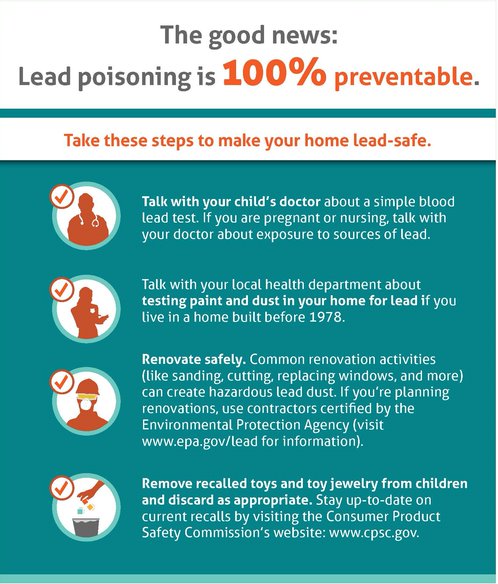 Illustration reference: OpenRN Nursing Mental Health and Community Concepts 2e Ch.18.2.
- Teach PFAS-reduction actions: replace damaged nonstick cookware, reduce packaged fast/microwave foods, use PFAS-capable filtration where available, and reduce household dust.
- Support community-level mitigation strategies for soil/air/water: safe waste disposal, emission reduction, public transport/active-transport supports, green-space expansion, wastewater and stormwater controls.
- Reinforce right-to-know principles and local reporting/notification pathways for hazardous-chemical releases.
- Teach individual-level environmental risk reduction: safe disposal of hazardous waste/medications/electronics, reduced pesticide use, safer food/water sourcing, lower single-use-plastic use, and indoor-ventilation/cleaning routines.
- Teach behavior adaptation for environmental alerts: avoid outdoor exertion when air quality is poor and avoid visibly/known polluted water exposure.
- Encourage low-emission transport and energy practices where feasible (public transit, walking/cycling, efficient appliance use, vehicle maintenance).
- Use EPA-style four-step risk framing in community communication so hazards, exposure likelihood, and uncertainty are transparent.
- Apply precautionary controls when credible harm risk exists despite incomplete certainty (for example temporary exposure reduction while testing continues).
- Implement I PREPARE-guided care plans with referrals/resources and exposure-specific education follow-up.
- Use pediatric-focused environmental home assessment tools when children are exposed to substandard or suspected contaminated housing.
- Perform community assessments with both environmental-data tools and direct observation (for example Envirofacts plus windshield survey) and escalate priority hazards.
- Coordinate interdisciplinary support (for example social work/public-health services) for immediate risk mitigation when household water/air safety is uncertain.
Exposure-Context Miss
Treating symptoms without exposure assessment increases recurrence risk and delays preventable harm reduction.
Pharmacology
Pharmacologic treatment can stabilize exposure-related illness, but durable population outcomes require parallel exposure reduction and environmental-risk prevention.
Clinical Judgment Application
Clinical Scenario
A community clinic identifies repeated asthma and COPD exacerbations among residents living near major traffic corridors and substandard housing.
- Recognize Cues: Recurrent respiratory events cluster by location and living conditions.
- Analyze Cues: Environmental exposure likely contributes to repeated exacerbation risk.
- Prioritize Hypotheses: Exposure-reduction planning is required in parallel with medication management.
- Generate Solutions: Add environmental screening, tailored education, and community mitigation referrals.
- Take Action: Implement risk communication and interagency referral plan while managing acute symptoms.
- Evaluate Outcomes: Exacerbation frequency and urgent-care utilization decrease over follow-up.
Related Concepts
- social-determinants-of-health - Structural conditions that shape environmental hazard distribution.
- individual-and-environmental-safety-in-nursing-practice - Practical safety-risk assessment and prevention workflows.
- healthy-people-2030-health-equity-and-social-determinants - Policy and indicator framework for equity-focused population action.
- disaster-preparedness-response-and-recovery-in-community-health-nursing - Escalation pathways for climate- and hazard-driven emergencies.
- community-health-needs-assessment-and-program-planning - Community-level assessment and prioritization workflows that complement environmental surveys.