
Conduct, Oppositional, and Disruptive Mood Disorders
Key Points
- This group includes conduct disorder, oppositional defiant disorder, and disruptive mood dysregulation disorder.
- Conduct disorder has the highest risk for legal, safety, and long-term antisocial outcomes if untreated.
- ODD often presents as persistent defiance/hostility; DMDD centers on chronic irritability and severe outbursts.
- Family-focused behavioral interventions and multisystem collaboration are core treatment components.
- ODD and CD diagnosis requires age/context-sensitive pattern assessment over time, not isolated conflict episodes.
- Prognostic escalation matters: part of ODD progresses to CD, and severe CD can progress to adult antisocial patterns.
Pathophysiology
Conduct Oppositional And Disruptive Mood Disorders emerge from interacting neurobiologic vulnerability and environmental stressors, including trauma exposure, family instability, community violence, and inconsistent discipline structures.
Emotion regulation deficits, impulsivity, and reinforcement of maladaptive behavior cycles sustain symptom progression. Early intervention can alter this developmental trajectory.
Classification
- Conduct disorder (CD): Persistent aggression and serious rule violations across contexts.
- Oppositional defiant disorder (ODD): Angry/irritable mood, argumentative/defiant behavior, or vindictiveness pattern lasting at least 6 months.
- Disruptive mood dysregulation disorder (DMDD): Severe recurrent outbursts with chronic irritability and early onset.
- DMDD age context: Symptoms begin before age 10 and must cause clear impairment across settings.
- ODD epidemiology/onset: Common pediatric disorder (reported up to about 16% in school-age/adolescent groups), usually beginning before age 8.
- ODD behavior target pattern: Defiance is often most evident toward familiar authority figures (for example caregivers/teachers), not across all relationships equally.
- ODD vs CD distinction: ODD does not require severe antisocial acts (for example serious aggression/property crimes/law violation) that characterize CD.
- ODD severity by setting: Mild (one setting), moderate (two settings), severe (three or more settings).
- ODD pediatric frequency rule: Under age 5, symptoms occur on most days for at least 6 months; age 5 and older, at least weekly for at least 6 months.
- CD onset specifiers: Childhood-onset (before age 10), adolescent-onset (no symptoms before age 10), or unspecified onset.
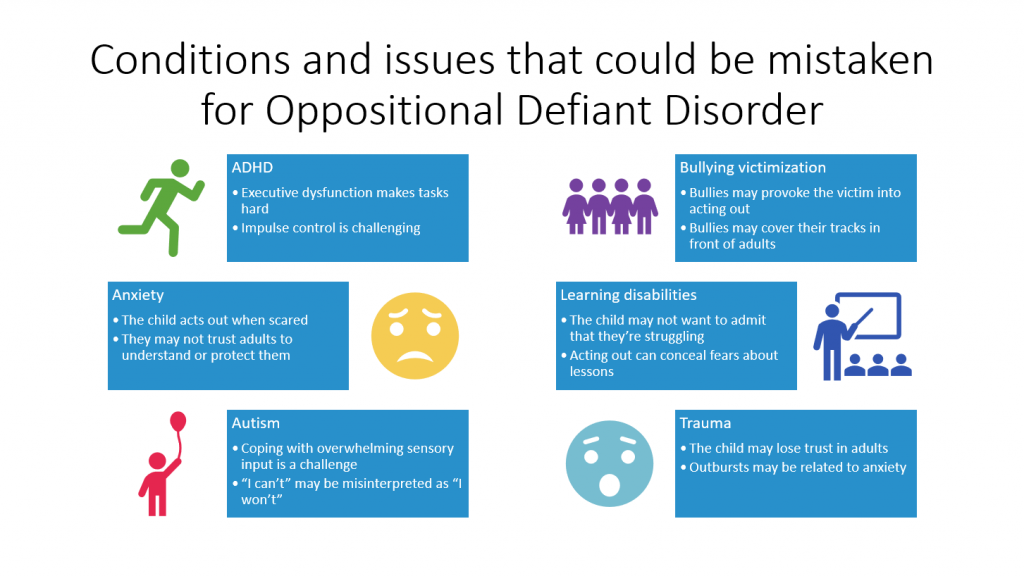 Illustration reference: OpenRN Nursing Mental Health and Community Concepts 2e Ch.12.2.
Nursing Assessment
NCLEX Focus
Prioritize safety, severity, and context while differentiating behavior disorder from isolated situational conflict.
- Assess behavior frequency, severity, and duration across home, school, and peer environments.
- For ODD, assess specific patterns such as temper loss, anger/irritability, arguing with adults/authority, active defiance, deliberate annoyance of others, blaming others, and spiteful/vindictive behavior.
- Assess aggression risk, cruelty behaviors, property destruction, and legal involvement.
- For CD, document behavior categories: aggression to people/animals, property destruction, deceit/theft, and serious rule violations (for example truancy/running away/nighttime curfew violation before age 13).
- Assess for limited prosocial emotions (lack of remorse, lack of empathy, unconcern about performance, shallow/insincere affect).
- Assess mood symptoms, trauma history, learning issues, and substance exposure.
- Assess family interaction patterns, caregiver stress, and current discipline approaches.
- Assess school functioning, attendance, and protective factors (activities, mentoring, stable supports).
Nursing Interventions
- Teach parent management strategies, including consistent limits, brief time-out, and positive reinforcement.
- Coach parents to prioritize conflicts, avoid escalating power struggles, and use calm communication instead of shouting matches.
- Support structured “special time” and child-directed play to rebuild secure parent-child connection.
- Coordinate school behavior supports and interdisciplinary communication.
- Encourage collaboration with teachers/coaches and screen for learning disorders when school behavior concerns are present.
- Refer to evidence-based therapy, including multisystemic treatment when severity warrants.
- Use multisystemic treatment (often 3-5 months, home/school/community based) for higher-severity conduct patterns to reduce delinquency and family dysfunction risk.
- For ODD, support parent management training, anger-management psychotherapy, family therapy, CBT/problem-solving skill work, and peer social-skills development.
- For CD, reinforce early referral to child/adolescent mental health specialists; untreated severe patterns are associated with persistent adult adaptation failure and incarceration risk.
- Promote strengths/protective-factor identification and crisis/safety planning.
- Promote caregiver stress regulation and respite planning to sustain consistent parenting responses.
Escalation Risk
Punitive, inconsistent responses without therapeutic structure can reinforce aggression and worsen outcomes.
Pharmacology
Medication is not first-line for ODD or conduct disorder; primary treatment is behavioral/family intervention. Medications may be used for severe aggression or co-occurring psychiatric symptoms under specialist supervision. Selected agents may include targeted antipsychotic or symptom-focused options when behavioral approaches are insufficient. For DMDD, there is no specific FDA-approved medication; prescribing is symptom-targeted and adjunctive to psychotherapy.
Nurses monitor metabolic, neurologic, sedation, and behavioral response risks while reinforcing family and therapy adherence.
Clinical Judgment Application
Clinical Scenario
An adolescent has repeated school fights, truancy, property damage, and escalating conflict at home despite prior counseling.
- Recognize Cues: Multi-setting severe conduct symptoms with safety and legal risk.
- Analyze Cues: Pattern supports conduct disorder with high progression risk.
- Prioritize Hypotheses: Immediate priorities are safety containment and family-system intervention.
- Generate Solutions: Implement multisystemic, school, and parent-management strategies.
- Take Action: Initiate coordinated treatment with clear behavioral goals and monitoring.
- Evaluate Outcomes: Reduced aggression, improved attendance, and more stable family functioning.
Related Concepts
- attention-deficit-hyperactivity-disorder - Common comorbidity and differential issue in disruptive behavior.
- anxiety-related-disorders - Irritability and dysregulation can overlap with anxiety pathways.
- trauma-informed-care - Essential when adversity contributes to behavior patterns.
- family-support-systems - Family engagement drives treatment success.
- client-advocacy - Required for coordinated school, legal, and mental health supports.