
Just Culture in Health Care Safety Reporting and Accountability
Key Points
- Just Culture promotes error reporting while maintaining fair accountability.
- Leaders are accountable for creating psychologically safe reporting systems.
- Error analysis separates simple human error, at-risk behavior, and reckless behavior.
- Responses differ by cause: console and redesign systems, coach risky choices, and discipline reckless misconduct.
- Reporting and learning cultures fail when blame, intimidation, or burnout are ignored.
- ANA formally endorsed Just Culture principles in 2010, reinforcing balanced accountability and system learning.
- Near misses and sentinel events should both trigger transparent review, with RCA and human-factors analysis scaled to severity.
- Just Culture is one component of a broader culture of safety that also requires active reporting and ongoing organizational learning.
- Just Culture is not a “no-blame” model; conscious disregard of substantial risk still requires remedial or punitive accountability.
- Apparent individual medication errors may represent stacked system failures (orientation gaps, safety-tool bypass normalization, and weak handoff controls).
- Medication-error prevention should prioritize early ordering-stage controls because many events originate before bedside administration.
Pathophysiology
Just Culture is a systems-safety framework, not a biologic process. It addresses how organizations interpret and respond to errors so that staff report near misses and adverse events without concealment.
When organizations rely on blame rather than analysis, error reporting falls and preventable risks persist. A Just Culture uses trust, transparency, and root cause analysis to improve system reliability while still addressing unsafe choices.
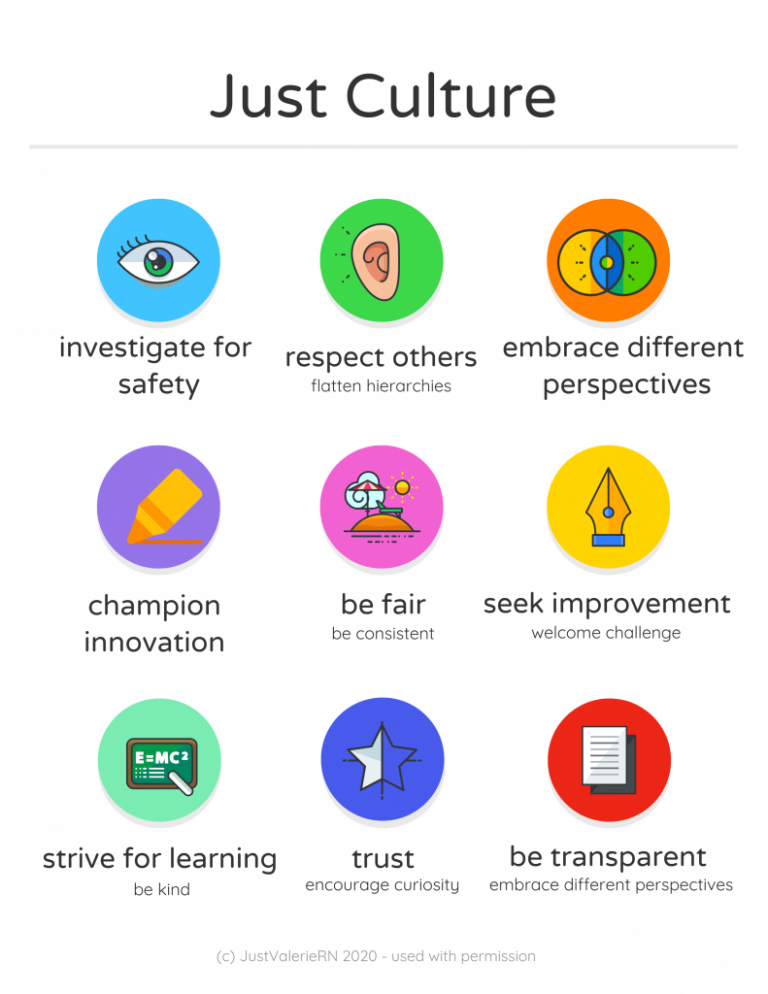 Illustration reference: OpenRN Health Alterations Ch.1.2.
Systems theory supports this model by treating errors as outcomes of interactions between people, workflow, tools, environment, and policy instead of reducing every event to individual fault.
Reason’s Swiss cheese model aligns with this approach: harm occurs when multiple weak barriers line up, so prevention must strengthen layered safeguards across prescribing, dispensing, and administration rather than relying on a single person.
Classification
- Simple human error: Unintentional slip/lapse, usually linked to system weaknesses.
- At-risk behavior: Risk-increasing choice where danger is underestimated or normalized.
- Workaround-risk behavior: Rule-circumventing actions intended to achieve care goals but that increase latent safety risk.
- Reckless behavior: Conscious disregard of substantial, unjustifiable risk.
- Reporting culture: Staff report errors and near misses promptly.
- Learning culture: Teams use reported events to implement durable system changes.
- Culture-of-safety triad: Just culture (fair accountability), reporting culture (speak-up/incident reporting), and learning culture (feedback and process redesign).
- Response ladder: Console for human error, coach for at-risk behavior, and punish/remediate for reckless behavior while correcting any contributing system defects.
- Transition-assignment risk domain: Float/travel assignments require unit-specific competency validation before high-risk tasks to prevent system-induced error.
Nursing Assessment
NCLEX Focus
Evaluate both the behavior and the system context before assigning individual blame.
- Assess whether the event reflects a process weakness, behavioral choice, or reckless disregard.
- Assess if staff fear reprisal, intimidation, or reputational harm after reporting.
- Assess whether leadership provides feedback and closes the loop after reports.
- Assess burnout and workload conditions that increase concealment and risk-taking.
- Assess whether near misses are treated as learning opportunities, not ignored.
- When evaluating employment settings, assess how the organization operationalizes culture-of-safety and Just Culture in policy and daily practice.
- During hiring interviews, assess how the organization handles error reporting, feedback, and Just Culture implementation in practice.
Nursing Interventions
- Report errors and near misses promptly using objective, nonpunitive language.
- Complete incident reports per policy (for example medication errors and patient falls) so events enter formal risk-review pathways.
- Participate in root cause analysis to identify process contributors and redesign opportunities.
- Classify and escalate near misses, never events, and sentinel events using organizational policy thresholds.
- For simple human error, prioritize system fixes and supportive coaching.
- In an immediate unsafe act, use directive stop-the-line intervention to protect the patient, then transition to objective debrief and behavior classification.
- For at-risk behavior, apply targeted coaching, education, and monitoring for safer choices.
- For at-risk behavior, remove incentives that reward shortcuts and add incentives for safer behavior patterns.
- For workaround-driven at-risk behavior, investigate why policy bypass seemed necessary and redesign workflow/policy where system friction is contributing.
- For reckless behavior, follow policy for remedial or disciplinary action.
- Escalate intimidation or retaliation that suppresses reporting.
- Reinforce shared accountability: individuals own choices, leadership owns system safety.
- In medication-event reviews, explicitly audit onboarding/float readiness, device-training adequacy, and bedside-handoff reliability before labeling an event as individual fault.
- In medication-event reviews, prioritize ordering-stage and communication controls (for example read-back for verbal orders, abbreviation safety, and CPOE checks) before relying on end-stage interception.
- Use shared-accountability expectations in orientation and precepting (preparedness, professionalism, ethical/legal practice, and reporting of errors/near misses) to strengthen early safety habits.
Blame-Culture Risk
Punishing all errors equally drives underreporting and increases repeat harm.
Pharmacology
Medication-event review should classify behavior correctly. Look-alike/sound-alike layout failures suggest system redesign, while willful safety bypass requires accountability action.
Clinical Judgment Application
Clinical Scenario
A nurse gives the wrong dose after overriding a scanner alert without clarification.
- Recognize Cues: A safety warning was bypassed and harm occurred.
- Analyze Cues: Determine whether this was system-driven confusion, at-risk normalization, or reckless disregard.
- Prioritize Hypotheses: Immediate priorities are patient stabilization and accurate event reporting.
- Generate Solutions: Launch RCA, classify behavior, and define system/individual corrective actions.
- Take Action: Implement redesign and coaching or disciplinary pathway per findings.
- Evaluate Outcomes: Reporting trust and medication safety metrics improve.
Related Concepts
- organizational-culture-patient-centered-collaborative-and-safety-frameworks - System context for safety-culture operations.
- quality-improvement-nurse-role-and-qapi - QI structures that convert reports into process change.
- medication-error-reporting-and-escalation - Event-reporting workflow that feeds Just Culture review.
Self-Check
- How should responses differ between simple human error and reckless behavior?
- Why is leadership feedback essential to a reporting culture?
- Which signs suggest a unit is operating under blame culture rather than Just Culture?