
Capnography and ETCO2 Monitoring in Care
Key Points
- Capnography measures end-tidal carbon dioxide (ETCO2) as a ventilation indicator.
- Normal ETCO2 range is 35 to 45 mm Hg.
- ETCO2 monitoring is especially useful in critically ill and low-perfusion states.
- Waveform pattern changes can signal evolving airway or pulmonary pathology.
- ETCO2 trend changes can identify respiratory depression earlier than pulse oximetry in many settings.
Pathophysiology
Capnography reflects exhaled carbon dioxide at end expiration and provides dynamic information about ventilation effectiveness. Because it trends breath-to-breath change, it can reveal deterioration earlier than intermittent assessments alone.
In unstable cardiopulmonary conditions, ETCO2 context helps clinicians evaluate ventilatory status, treatment response, and need for escalation. Waveform interpretation extends value beyond a single number by showing respiratory-cycle behavior.
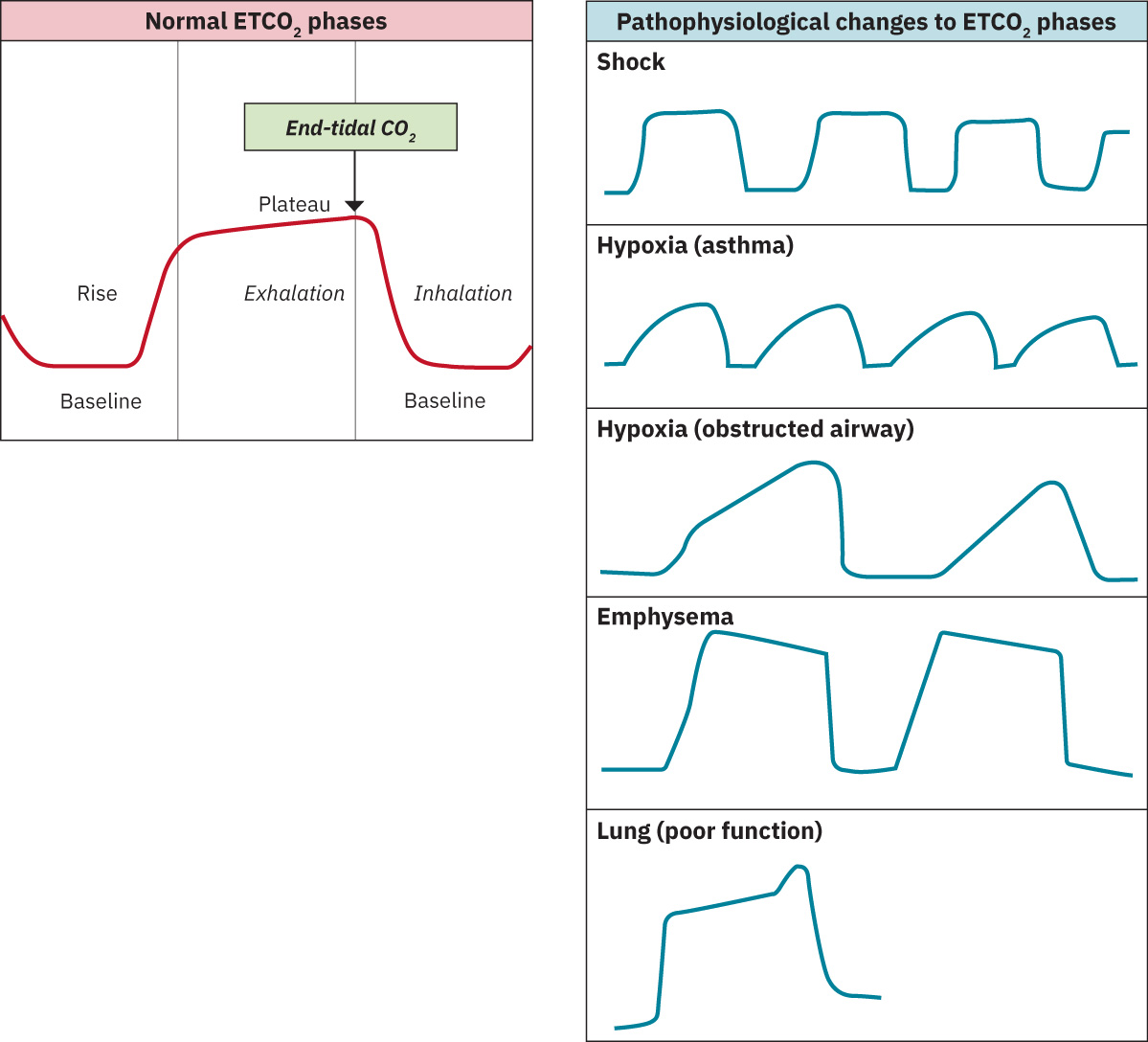 Illustration reference: OpenStax Clinical Nursing Skills Ch.18.3.
Classification
- Nasal-cannula ETCO2: Noninvasive monitoring while receiving oxygen support.
- Mask-associated ETCO2: Monitoring during higher-level oxygen delivery interfaces such as simple mask, CPAP, and nonrebreather support.
- Ventilator-integrated ETCO2: Continuous waveform monitoring in mechanically ventilated care.
Nursing Assessment
NCLEX Focus
Expect prioritization questions on early recognition of ventilation decline using ETCO2 trend and waveform changes.
- Assess ETCO2 value against expected range and clinical context.
- Assess waveform morphology for deviation from expected pattern.
- Assess for abrupt waveform-shape deviations that can suggest pulmonary embolism, pneumothorax, or airway obstruction.
- Assess for signs of hypoperfusion, airway obstruction, or worsening respiratory effort.
- Assess treatment effectiveness by trending ETCO2 before and after interventions.
- In spontaneous breathing patients with high respiratory risk, use ETCO2 trend alongside respiratory effort and mental-status change to detect early decline.
Nursing Interventions
- Initiate ETCO2 monitoring when ordered for high-risk respiratory or perfusion conditions.
- Verify proper interface setup and signal quality to reduce false interpretation.
- Trend ETCO2 with respiratory rate, pulse oximetry, and overall patient status.
- When ETCO2 worsens while SpO2 appears stable, treat this as a possible early ventilation warning and reassess immediately.
- Communicate abrupt ETCO2 or waveform changes promptly for rapid reassessment.
- Reevaluate interventions based on combined ETCO2 trend and bedside findings.
Isolated Number Pitfall
ETCO2 should be interpreted with waveform pattern and full cardiopulmonary assessment, not as a stand-alone value.
Pharmacology
ETCO2 trends can inform response to respiratory therapies and procedural sedation management by revealing evolving ventilation adequacy during treatment.
Clinical Judgment Application
Clinical Scenario
A critically ill patient in possible shock is receiving oxygen support and continuous ETCO2 monitoring.
- Recognize Cues: ETCO2 trend begins falling while respiratory distress signs worsen.
- Analyze Cues: Pattern suggests compromised ventilation-perfusion status and possible clinical decline.
- Prioritize Hypotheses: Airway compromise, perfusion failure, or rapid respiratory deterioration are urgent concerns.
- Generate Solutions: Reassess airway, oxygen-delivery setup, and need for escalation.
- Take Action: Report trend change and initiate rapid team reassessment.
- Evaluate Outcomes: Stabilization of ETCO2 and clinical status supports treatment effectiveness.
Related Concepts
- arterial-vs-venous-blood-gas-use-in-care - Blood gases complement ETCO2 when deeper acid-base or oxygenation detail is needed.
- noninvasive-positive-pressure-ventilation - ETCO2 trends help assess response to noninvasive ventilatory support.
- advanced-airways-and-intubation - Deteriorating ETCO2 can signal need for airway escalation.
- respiratory-failure - Ventilation trends aid early recognition of failure progression.
- vital-signs - ETCO2 interpretation is integrated with respiratory and hemodynamic assessment.
Self-Check
- Why can ETCO2 trend monitoring provide earlier warning than intermittent checks alone?
- What is the normal ETCO2 range, and how should it be interpreted clinically?
- Why is waveform interpretation important in capnography-based decision-making?