
Focused Health History Interview
Key Points
- Focused history collection guides diagnosis, treatment planning, and risk screening.
- Core domains include prior illnesses, allergies, medications, immunizations, family history, and social/environmental factors.
- Open-ended and clarifying questions improve completeness and accuracy of subjective data.
- The interview starts with the chief complaint and reason for seeking care, then progresses through structured standard questions.
- Focused history targets the immediate reason for care, while comprehensive history expands to broader past, family, and social risk context when indicated.
- Holistic interview scope should include coping resources, support systems, and spiritual/cultural preferences that may influence care decisions.
- History documentation is legal evidence and must be objective, specific, and accurate.
- Common health-record components include demographics, chief complaint/HPI, past history, family/social history, and review of systems.
Equipment
- Interview template or structured health-history form
- Documentation tool for real-time charting
- Interpreter access for language-discordant encounters
- Quiet setting that supports privacy and patient comfort
Procedure Steps
- Review available records before entering the room (demographics, history, medications, prior testing) to focus interview priorities.
- Verify patient identity using two identifiers (for example name and date of birth) and establish a private, low-distraction interview setting.
- Explain interview purpose and expected duration to reduce anxiety.
- Begin with open-ended questions to elicit chief concerns and symptom narrative.
- Use setting-appropriate framing for the first question (for example chief complaint in clinic/ED or main health needs during inpatient follow-up).
- If reported concerns include high-risk red flags (for example chest pain, difficulty breathing, sudden vision/speech change, new weakness/paralysis, uncontrolled bleeding, or self-harm thoughts), pause routine history flow and escalate immediately per policy.
- Combine directed focused questions with open-ended prompts to capture both symptom detail and patient perception of illness/life processes.
- Use structured symptom clarification (for example PQRSTU: provocation/palliation, quality, region, severity, timing/treatment, understanding) and apply it to pain and nonpain symptoms.
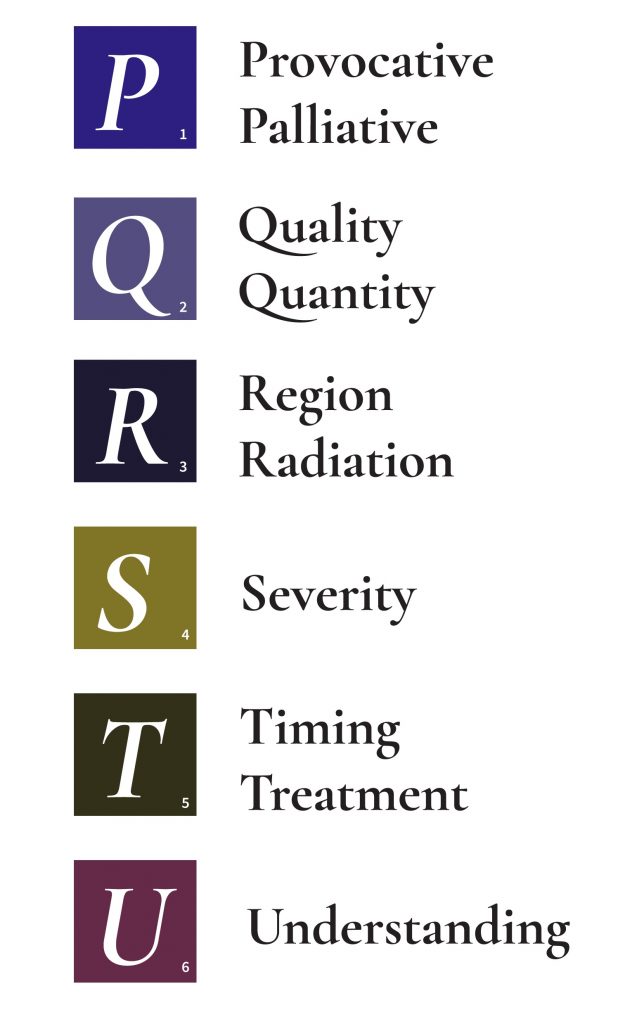 Illustration reference: OpenRN Nursing Skills 2e Ch.2.5.
- When SOAP-style HPI detail is needed, OLDCARTS can be used (onset, location, duration, characterization, alleviating/aggravating factors, radiation, temporal pattern, severity).
- Observe nonverbal cues during interview (for example facial expression, guarding, posture change, affect shift) and validate their meaning with follow-up questions.
- Collect core history domains: demographics, prior diseases, hospitalizations, surgeries, injuries, childhood illnesses, and major chronic conditions.
- In demographic intake, separate biological sex, gender identity, and preferred pronouns, and confirm preferred spoken language and interpreter need.
- Ask targeted questions on allergies, medications, immunizations, and current health goals; capture the reaction pattern for each reported allergen.
- For medications, collect prescriptions, over-the-counter products, vitamins, and herbal supplements, and confirm why and how the patient takes each one.
- Perform medication reconciliation by comparing the current medication list with prior documented lists at every hospitalization and clinic visit.
- If adherence responses are “no” or “sometimes,” use open-ended follow-up to identify barriers before finalizing education plans.
- Use open relationship-status prompts (for example, “Tell me about your relationship status”) and avoid assumption-based wording.
- Ask about resuscitation preferences and whether advance directives (for example living will or health-care POA) are already on file.
- Offer advance-directive information resources when the patient reports no document on file or requests clarification.
- Obtain details for chronic illnesses (diagnosis timing, current treatment, specialist involvement, functional effect, coping, and complications/disability when present).
- Obtain history of acute illnesses, surgeries, accidents, or injuries and any associated complications, and include reproductive history when clinically relevant.
- Obtain family disease history and relevant social/environmental exposures (for example tobacco, alcohol, drug use, stress/life context).
- In adolescent-focused or developmentally sensitive interviews, HEADSS can structure social history domains (Home/Environment, Education-Employment-Eating, Activities, Drugs, Sexuality, Suicide/Depression).
- Assess coping resources, support network reliability, and spiritual/cultural preferences that may affect treatment acceptance or care goals.
- Clarify whether key concerns represent current symptoms (actual problems) or risk indicators (potential problems) requiring preventive follow-up.
- Complete a review of systems to capture subjective findings not directly observable and surface symptoms the patient may not have considered relevant.
- Use clarifying follow-up questions to resolve ambiguities and timeline gaps.
- Validate preexisting chart data with the patient and correct or expand information as needed.
- Maintain empathetic, conversational communication style throughout the interview.
- While obtaining history data, continue concurrent general-survey observation for immediate stability or distress cues.
- Document findings promptly and communicate urgent risk findings to the care team.
- Reinforce patient-centered interviewing by treating the patient as the primary source of information whenever possible.
- For functional-health review, use a clear opener (for example, “I would like to ask about factors that affect your day-to-day functioning”) and invite additional concerns throughout the section.
- Screen relationship and support context, including social isolation, recent meaningful losses, and whether the patient feels safe in current relationships.
- Use sensitive, professional sexuality-reproduction questions that include sexual-health concerns and safety in intimate practices without assumption-based language.
- Use nonjudgmental substance-use questioning and distinguish use from abuse by assessing frequency, dependence cues, and disruption of work/relationships/housing.
- Include open-ended value-belief/spirituality prompts when relevant to care decisions (for example, “Can you share spiritual or religious practices that are important during your stay?”).
- In self-perception review, ask about identity, body-image/function changes, mood-state shifts, and coping toward the end of the interview after baseline rapport is established.
- Treat violence/trauma disclosures, suicidal thinking, and unsafe-environment cues as immediate safety priorities: follow agency emergency workflow, fulfill mandated reporting for suspected child/elder abuse, and if suicide risk is high (for example specific plan and near-term intent, especially within 48 hours), do not leave the patient alone while arranging emergent care.
- Include environmental-health screening (home/neighborhood safety, violence exposure, transportation, food/medication affordability, and other social-determinant barriers) when evaluating health-perception and self-management capacity.
- Integrate review-of-systems questions into corresponding body-system exam flow when possible (for example asking bowel-pattern questions during abdominal assessment) to improve efficiency and symptom-context accuracy.
- Before starting interview questions, perform hand hygiene, check for transmission-based precautions, and address immediate readiness needs (for example pain, toileting, glasses/hearing aids) to support accurate participation.
- When leaving the room, complete a safety sweep (call light in reach, bed low/locked, side rails secured as indicated, table in reach, and fall hazards removed) and report urgent concerns per policy.
- During acute exacerbation admissions of chronic disease, add focused questions on current self-management knowledge, home-treatment routine, and available interdisciplinary/community supports to identify preventable discharge-risk gaps early.
Note
Data collection, validation, and documentation are often concurrent rather than strictly linear during a live assessment encounter.
Documentation Essentials
- Include key demographic fields used for clinical and administrative decisions (for example preferred pronouns, religion, allergy status, resuscitation status, and responsible payer/contact details).
- In demographic documentation, keep biological sex, gender identity, and preferred pronouns as separate data elements.
- Include emergency-contact name, relationship, and callback number as part of initial intake reliability/safety planning.
- Elicit the chief complaint with open-ended prompts and avoid leading questions that suggest an answer.
- For symptom localization, ask the patient to point to the involved area when verbal region description is unclear.
- Record each reported allergy with the specific reaction, not only the allergen name.
- Ask specifically about nonprescription medications, herbal products, vitamins, and other nonregulated substances.
- Perform and document medication reconciliation against prior lists at every hospitalization and clinic visit.
- If the patient reports nonadherence (“no” or “sometimes”), document open-ended barrier exploration before closing the plan.
- If the patient is language-discordant, document interpreter offer/use and avoid assumption that basic conversational English is sufficient for clinical consent/history detail.
- Include social-history questions (for example tobacco, alcohol, sexual health, activity, diet, safety risks) to identify health-promotion opportunities.
- Document immediate blood-relative family history (for example parents, grandparents, siblings), including major disease patterns and current age or age/cause of death when known.
- Document chronic-condition timeline, specialist follow-up, current treatment approach, coping impact, and prior complications when available.
- Document coping resources/support-system limits and spiritual/cultural care preferences when they influence care planning.
- Use non-assumptive relationship-status wording and document the patient’s own terms.
- Document resuscitation-preference discussion, whether advance directives are on file, and whether education/resources were offered.
- Document nonjudgmental substance-use assessment with distinction between use and abuse, including functional impact and readiness to change when disclosed.
- Document violence/trauma screening findings, immediate danger actions, and mandated-reporting steps when suspected child or elder abuse is identified.
- For suicide-risk positives, document follow-up questions on current ideation, plan specificity, means access, and near-term timing (including whether self-harm is planned within 48 hours), then record observation/escalation actions.
- Document environmental-health safety findings as SDOH data (for example unsafe housing/neighborhood conditions, transit/access limits, and basic-needs barriers).
- When ROS prompts are integrated into physical-exam workflow, document the linked subjective report with the corresponding body-system section.
- If interview flow is deferred for acute distress (for example chest pain or breathing difficulty), document defer reason, emergency escalation actions, and restart timing/plan.
- Distinguish documented concerns as current manifestations versus future risk indicators when prioritizing follow-up.
- If responses appear inconsistent (for example high severity score but “tolerable” description), continue focused follow-up to identify context such as rest-versus-activity variation.
- Document significant nonverbal cues and whether they align or conflict with patient-reported symptoms.
- In ROS documentation, record whether each system finding is present or absent using site policy language (for example positive/negative, +/-, or unremarkable).
- When allergy history is reported, document symptom details that distinguish likely adverse effects from probable true allergy patterns.
- For chronic-disease exacerbation admissions, document patient-reported self-management knowledge gaps, current home-management resources, and interdisciplinary-support availability that may affect post-discharge safety.
- If information comes from a secondary source, document who provided it.
- If the patient cannot provide reliable history, document collateral sources used (for example family/caregiver interview, medication lists, prior records, or advance-directive documents).
- When charting in the EHR during interview, document use of patient-centered communication behaviors (for example brief charting explanations and return to eye-level engagement).
- Use agency-specific history forms for standard fields and place additional clinically relevant details not captured on the form into the associated progress note.
Common Errors
- Relying only on closed questions → incomplete symptom and context data.
- Skipping social/environmental history → missed modifiable risk factors.
- Ignoring language/cognitive barriers → inaccurate history and unsafe planning.
- Delayed documentation → loss of detail and handoff gaps.
Related
- therapeutic-communication - Communication style directly affects interview trust and data quality.
- respiratory-failure - Focused history can identify high-risk symptom patterns requiring urgent escalation.
- general-survey-and-anthropometric-measurement-initial-assessment - Health-history interview and general-survey observation occur concurrently in early assessment.